Global Semiconductor's "Blackout" Moment: From Doubling Euphoria to Bear Market Alarm
Introduction
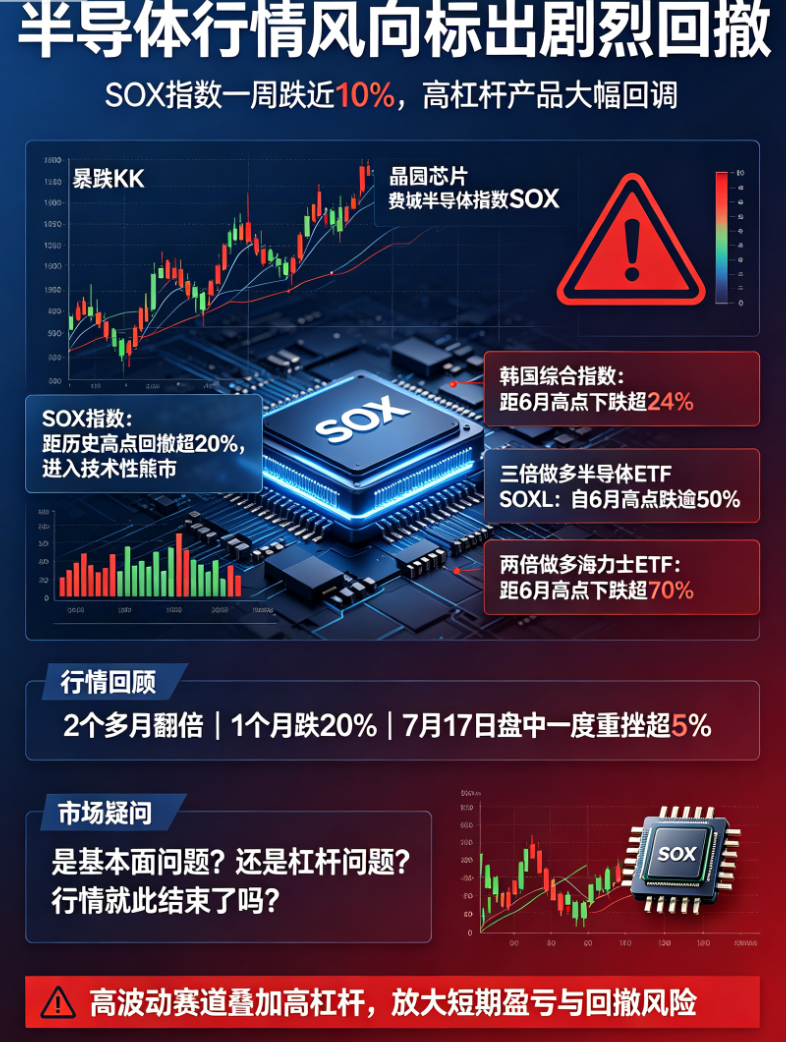
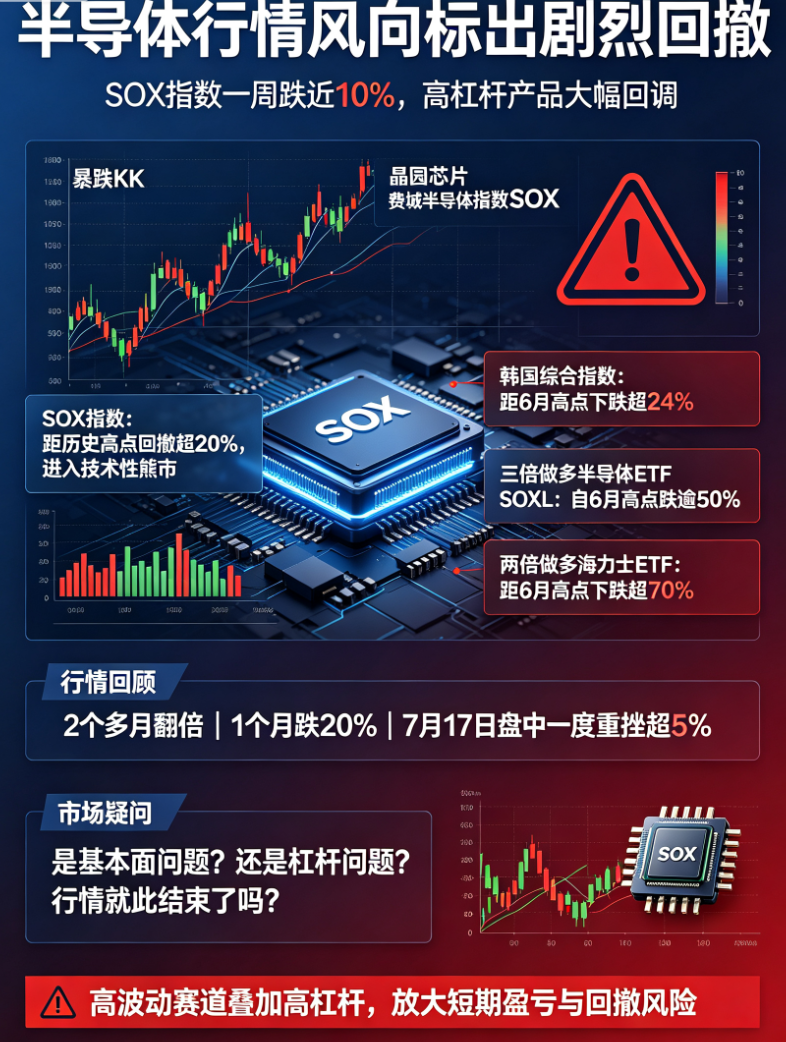
In just over two months, the global semiconductor industry has witnessed a breathtaking roller-coaster ride. From the joy of doubling gains to the panic of a 20% plunge within a month, the Philadelphia Semiconductor Index (SOX)—a key barometer for the global semiconductor market—is sounding a shrill alarm to the entire financial world. On July 17, SOX briefly tumbled over 5% intraday, though it rebounded somewhat to close down 1.63%, with a weekly cumulative loss approaching 10%. The retreat from its record high on June 22 has exceeded 20%, officially crossing the threshold into a technical bear market. This sudden "blackout" leaves investors questioning: What exactly is happening in the semiconductor industry? Is this a fundamental reshaping or a collapse of leverage? Has the feast already ended?
Main Body
I. Dramatic Shift: From Euphoria to Panic
Entering July, volatility in the global semiconductor sector suddenly intensified. As of the close on July 17, not only had SOX plummeted nearly 10% in a single week, but Asia's KOSPI also suffered, retreating over 24% from its mid-June high and similarly entering technical bear market territory. This synchronized decline suggests the market is not undergoing a simple regional adjustment but a collective global repricing of semiconductor prospects.
Even more striking, some leveraged semiconductor ETFs have crashed far more than the index itself. For example, the Direxion Daily Semiconductor Bull 3X Shares (SOXL) has plummeted over 50% since June 22, though its year-to-date gain still barely exceeds 220%. Meanwhile, some 2X long SK Hynix ETFs have fallen over 70% from their June highs, nearly wiping out all gains from the past months. This devastating retreat exposes the massive bubble and fragility accumulated during the previous frenzied rally.
II. Analyzing the Sell-off: Fundamentals or Leverage?
In the midst of the sharp decline, two core questions need clarification: Is this a concern over industry fundamentals, or simply a liquidity crisis triggered by leveraged funds?
Fundamental Concerns
First, from a fundamental perspective, although demand for AI chips remains strong—especially with robust orders for leading firms like NVIDIA—the market is starting to worry about the sustainability of AI investment returns. As more companies are forced to follow AI infrastructure buildouts, the question of whether massive capital expenditures can translate into real revenue growth looms like a sword of Damocles. Additionally, sluggish recovery in consumer electronics such as smartphones and PCs, along with extended inventory digestion cycles for traditional chips, is putting pressure on non-AI semiconductor companies. This "ice and fire" landscape means that once AI expectations waver, the entire index is prone to resonant declines.
Amplification Effects of Leverage and Sentiment
However, the staggering drawdowns on ETF charts indicate that leverage issues cannot be ignored. During the preceding bull feast, vast amounts of hot money flooded in through leveraged ETFs and derivatives, driving the index rapidly higher. This structure inherently generates a self-reinforcing negative feedback during declines: index falls → leveraged ETF net asset value drops sharply → triggers forced liquidation or active stop-loss → further selling → index losses widen. Particularly after SOX broke through key technical support levels and entered a technical bear market, chain reactions from program trading and risk management systems accelerated the decline. Moreover, sharp directional shifts by some quantitative and hedge funds have intensified market turbulence.
III. Wall Street's Focus: The "Kimi Moment"
Amidst this upheaval, a key market event is repeatedly cited—the "Kimi Moment." This term originates from market reaction to a recent startup, Kimi (or other related AI applications), viewed as an industry catalyst similar to the earlier DeepSeek moment. Kimi's emergence showcases breakthroughs in long-text processing and logical reasoning by domestic large models, sparking renewed discussion on computing power demand patterns in the short term.
For global semiconductor investors, the "Kimi Moment" brings two contrasting inferences:
- Computing Power Demand Expansion Thesis: As more application scenarios explode, demand for High Bandwidth Memory (HBM) and advanced process logic chips will grow long-term, benefiting giants like SK Hynix, Samsung, and TSMC.
- Efficiency Disruption and Monopoly Erosion Thesis: If domestic AI can achieve performance comparable to top global models under constrained computing power, market reliance on and pricing power of high-end chips (e.g., NVIDIA's GPUs) may weaken, triggering valuation restructuring.
Wall Street's heightened attention to the "Kimi Moment" reflects that the market is at a sensitive turning point—investors are no longer satisfied with the simplistic narrative of "AI = computing power + chips," but are beginning to deeply analyze the true impact of different technology pathways on various supply chain segments within the semiconductor industry.
IV. Is the Rally Over?
Facing such a drastic correction, a larger question emerges: Has the long-term semiconductor uptrend completely ended?
In the short term, risk release may continue. Confirmation of a technical bear market often accompanies a phase of investor confidence collapse, coupled with external macroeconomic uncertainties (e.g., Federal Reserve policy, geopolitical tensions), making a period of low-range consolidation likely. Particularly for overhyped stocks and ETFs lacking earnings support, the risk of liquidity drying up remains.
But from a medium-to-long-term perspective, industry fundamentals have not fundamentally reversed. The AI revolution remains the theme of our era, and the logic of growing global demand for advanced semiconductors remains intact. Whether it's expansion of data centers, penetration of edge AI, or evolution of smart vehicles and industrial automation, all rely on chip support. This sell-off is more akin to a liquidation of previous excessive bubbles—a rational return after short-term euphoria.
For long-term investors, cyclical adjustments often breed new opportunities. However, the prerequisite is the ability to distinguish between "fake growth" and "true leaders." Companies with core technology moats in the AI supply chain that can continuously expand market share will stand out in the next upcycle.
Conclusion
The global semiconductor industry is experiencing a painful "blackout" moment. From euphoria to panic, from doubling to bear market, behind it lie both fundamental fluctuations and the amplifying effects of leverage mechanisms. Wall Street's focus on the "Kimi Moment" precisely illustrates that the market is shifting from simple sentiment-driven moves to more refined value reassessment.
In this context, simply calling a "top" or "bottom" is dangerous. Future trends will depend on the pace of AI technology deployment, global economic direction, and changes in financial market liquidity. What is certain is that the semiconductor story is far from over. Each "blackout" it experiences is ultimately for more efficient "charging" and to open new chapters at higher levels of competition. For investors, managing risk, maintaining patience, and focusing on core assets may be the safest path through current volatility.