As requested, based on the reference content provided, I have created a professional, in-depth, and structurally complete article. The article uses Traditional Chinese and follows your requirements on style and word count.
Electronics Sector Accelerates Correction, Good Opportunity to Position After Full Risk Release
——In-depth Analysis Based on China Galaxy (HK6881) Research Report, July 19, 2026
Abstract: In July 2026, the global electronics industry experienced a sharp adjustment, with the A-share electronics sector particularly affected. After months of valuation expansion, short-term sentiment and profit-taking pressure were concentrated, triggering this accelerated correction. However, amid widespread panic and pessimism, a research report from the professional institution China Galaxy (HK6881) released on July 19 sent a different signal: sector risks have been largely released, and the long-term logic driven by fundamentals remains unchanged. Based on the core views of this report and combined with segment performance and industry trends, this article deeply analyzes the current investment value of the electronics industry, pointing out that after sufficient risk release, some areas are expected to lead the rebound and become frontrunners in the next cycle.
I. Introduction: Calm Observation Amid the Storm
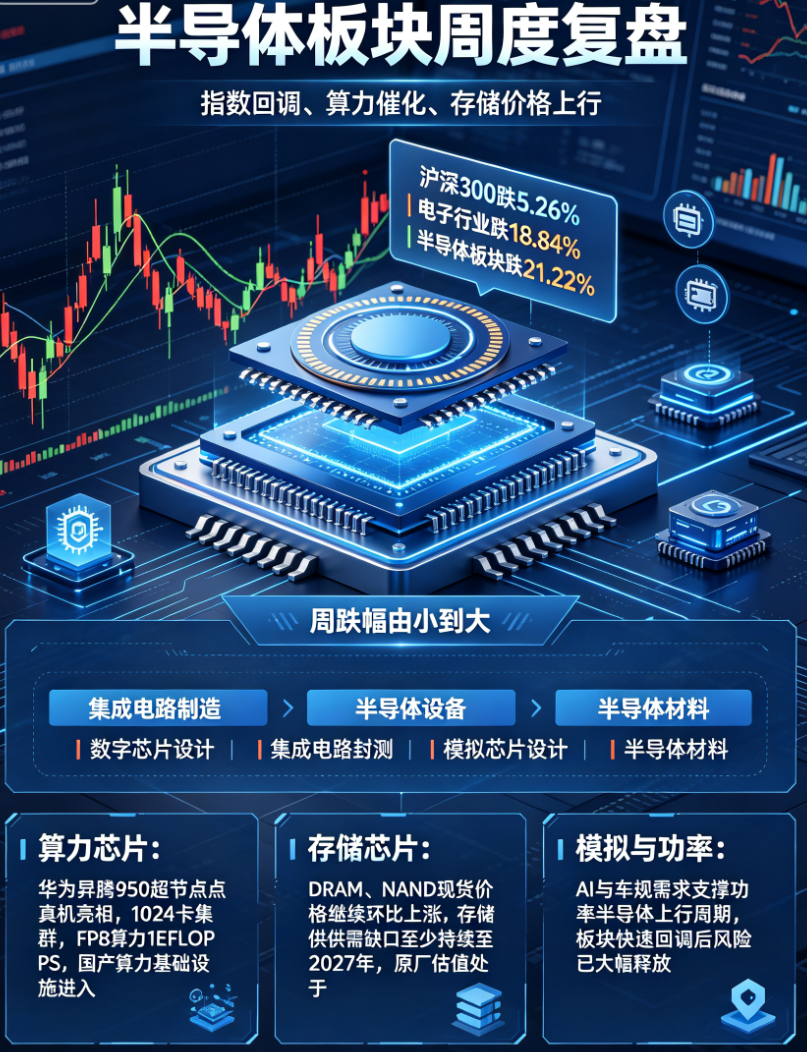
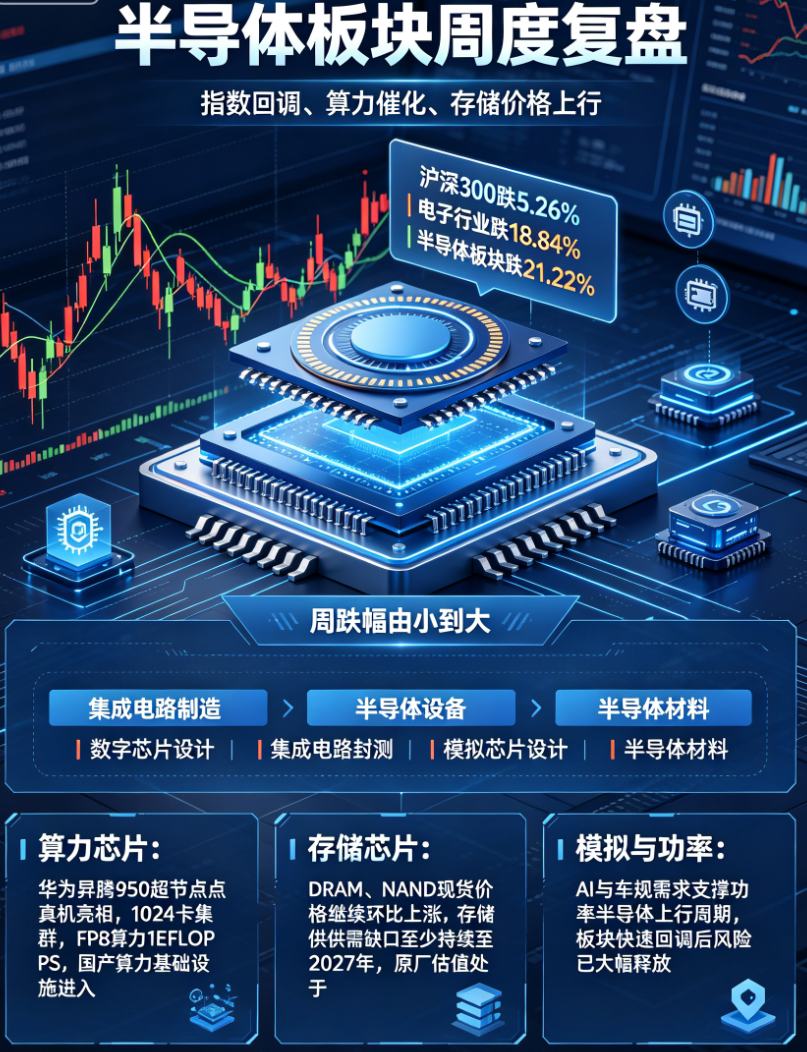
July 19, 2026, was a somber day for electronics industry investors on the Shanghai and Shenzhen stock exchanges. That week, the CSI 300 index fell 5.26%, while the electronics sector (Shenwan First-Level) dropped 18.84%, with the semiconductor sector (881121) plunging 21.22%, and several leading stocks experiencing rare consecutive limit-downs. Market sentiment was filled with panic, and terms like "industry winter" and "bubble burst" were rampant.
However, just when the market was most panicked, the research report from China Galaxy (HK6881) shone like a beacon in the dark. Titled "Sector Accelerates Correction, Risks Have Been Largely Released," the report's core view not only objectively described short-term market conditions but firmly reaffirmed the long-term investment logic. It reminded us that behind extreme pessimism, mispriced quality assets are often hidden. The accelerated market decline precisely reflects the rapid clearing of risks, providing rational investors with a rare window to position.
II. Market Review: A Tale of Ice and Fire Under Structural Divergence
This adjustment was not a uniform decline but showed significant structural characteristics. According to the report, the declines of sub-sectors in the electronics industry this week were ranked as follows: Integrated Circuit Manufacturing (884227) (-16.94%) > Digital Chip Design (884287) (-19.12%) > Semiconductor Equipment (884229) > Integrated Circuit Packaging and Testing (884228) > Analog Chip Design (884288) (-21.52%) > Semiconductor Materials (884091). This ranking clearly reveals the market's pricing logic: areas with stronger industrial moats and higher certainty of prosperity (such as wafer foundry) showed stronger resistance to decline, while sectors with more pronounced cyclicality and sensitivity to short-term sentiment (such as analog chips) bore the brunt of the sell-off.
2.1 Computing Chips: Huawei Ascend Supernode Debuts, Strengthening Localization Logic
The digital chip design sector (884287) fell 19.12% this week, but the positive factors within it should not be overlooked. The report specifically noted that the Huawei Ascend (886058) 950 supernode prototype officially debuted at the 2026 World Artificial Intelligence Conference (885728). This product, relying on innovative Lianku interconnection technology, achieved an ultra-large cluster of 1,024 cards, with FP8 computing power reaching 1 EFLOPS and FP4 computing power as high as 2 EFLOPS, along with an astonishing 256TB unified memory. This technological breakthrough essentially solves the long-standing bottleneck of large-scale communication in domestic computing clusters.
Key Insight: The emergence of the Huawei supernode marks a new stage where domestic computing infrastructure has moved from "usable" to "easy to use." This will significantly drive actual shipments of domestic AI chips, shifting from small-scale verification testing to large-scale, standardized cluster deployment. For the entire domestic computing industry chain—from upstream chip design and advanced packaging to downstream servers, switches, and cooling systems—a true demand explosion is coming. Therefore, despite short-term market sentiment leading to a broad decline in the digital chip design sector, companies with core technology and deep ties to the Huawei ecosystem have had their long-term value highlighted during this adjustment.
2.2 Memory Chips: Valuation Depressions Under Irrational Selling
The report's analysis of the memory chip sector (886042) is particularly thorough. Currently, the global memory sector is suffering from indiscriminate selling, yet in stark contrast, spot prices of DRAM and NAND are still rising month-over-month. The report cites industry consensus that the supply-demand gap in memory will persist at least until 2027. This means that in the foreseeable future, the industry's prosperity will not reverse but is likely to continue improving.
Investment Value Judgment: With such a severe divergence between fundamentals and market sentiment, the 2027 expected P/E ratios of memory manufacturers like SK Hynix (SKHY), Micron, and SanDisk (SNDK) have fallen significantly below 10x. For an industry in an upcycle with extremely high entry barriers, this valuation level is undoubtedly highly attractive. The market selling appears more as an overreaction to global macroeconomic uncertainties (such as U.S. recession expectations) rather than a denial of memory industry fundamentals. A-share memory-related companies, especially those deeply involved in the supply chains of ChangXin Memory Technologies and Yangtze Memory Technologies, are likely to see their valuation logic repaired and reshaped in the subsequent cycle.
2.3 Analog Chips and Power Semiconductors: Risk Clearing Under Cyclicality
The analog chip design sector (884288) fell 21.52% this week, while discrete devices (884090) dropped 14.89%. The report accurately pointed out that Infineon's decline far exceeded that of Texas Instruments, primarily due to Infineon's stronger cyclicality. This also explains why the A-share power semiconductor sector fell in sync with the global market—they are all in the same global semiconductor upcycle (883436).
Fundamental Support: The report emphasizes that "industry fundamentals remain unchanged." Downstream demand for power semiconductors—especially from AI server power management, new energy vehicle electric drive systems, and charging piles—remains strong. The rapid correction is essentially a valuation adjustment for the earlier rapid rise and a one-time pricing of global macro risks. After risks are fully released, the investment value of analog and power leaders with true product competitiveness and continued penetration into high-end automotive and AI applications will once again become apparent.
III. Industry Fundamentals: Resilience and Certainty
The core driver of this adjustment, as the report clearly points out, came from the sell-off in the memory sector. This contrasts sharply with the positive guidance provided by TSMC (TSM) at its Q2 2026 earnings call.
3.1 Wafer Foundry: The "Ballast" Effect of Logic Chips
TSMC's (TSM) latest financial results and guidance are undoubtedly strong: Q3 2026 revenue guidance midpoint is up 12.4% quarter-over-quarter, and full-year revenue growth is slightly above 40%; more importantly, the full-year capital expenditure (Capex) expectation was raised to US$60-64 billion. These figures comprehensively exceeded market expectations, indicating that demand for logic chips represented by AI chips and high-performance computing (HPC) remains extremely robust.
Key Insight: This forms an interesting contrast with the memory chip adjustment. If the memory chip decline was a "collateral damage" of market sentiment, the strength of the wafer foundry sector proves that the "backbone" of the entire semiconductor industry remains solid. The report's conclusion that "compared to the memory sector, the logic chip chain to which wafer foundry belongs has stronger resilience" is based on this fact. This means that in A-share semiconductor equipment, materials, and EDA localization areas, given their direct downstream connection to strong demand for logic chips and wafer foundry, the certainty of their fundamentals is far higher than the market imagines.
IV. Conclusions and Outlook: Grasping the Main Line Amid Danger and Opportunity
Based on the above analysis, we believe that the accelerated correction of the electronics sector in July 2026, while causing significant short-term impact on investors, is a healthy and positive risk release from a medium-to-long-term perspective. Through the sharp decline, the market has digested accumulated valuation bubbles and concerns about global macro uncertainties.
Core Conclusions:
- Risks are fully released: After this round of adjustment, sector valuations have fallen below historical midpoints. Especially in sub-sectors like memory and analog, significant irrational pricing has emerged. The report's statement that "risks have been largely released" is the most accurate assessment of the current market state.
- Fundamental logic remains unchanged: The three engines supporting the long-term development of the electronics industry—AI computing revolution, deepening localization, and cyclical recovery—remain strong. The debut of the Huawei supernode and TSMC's capital expenditure increase are the most powerful proofs.
- Structural opportunities become prominent: Future investment opportunities will no longer come from overall beta returns but more from deep alpha stock picking. Investors should focus on the following main lines:
- Domestic computing chain: Follow the Huawei ecosystem, focus on computing chips, advanced packaging, high-speed interconnection, and other core links.
- Undervalued memory leaders: Use market irrational selling to buy on dips memory chip companies and related equipment firms with long-term growth potential.
- High-certainty wafer foundry and equipment materials: Benefiting from global logic chip expansion and increased localization rate, these areas have the highest earnings growth certainty.
Every deep squat of the market is for a more powerful leap next time. For far-sighted investors, when panic sentiment reaches its peak, it is the best time to think calmly and decisively position. The second half of the electronics industry will no longer be a rally where everything rises together, but a protracted war testing vision and patience. On the soil of fully released risks, a new generation of growth stocks will inevitably break through the ground.