AI Computing Demand Surges, Semiconductor Equipment Sector Strengthens
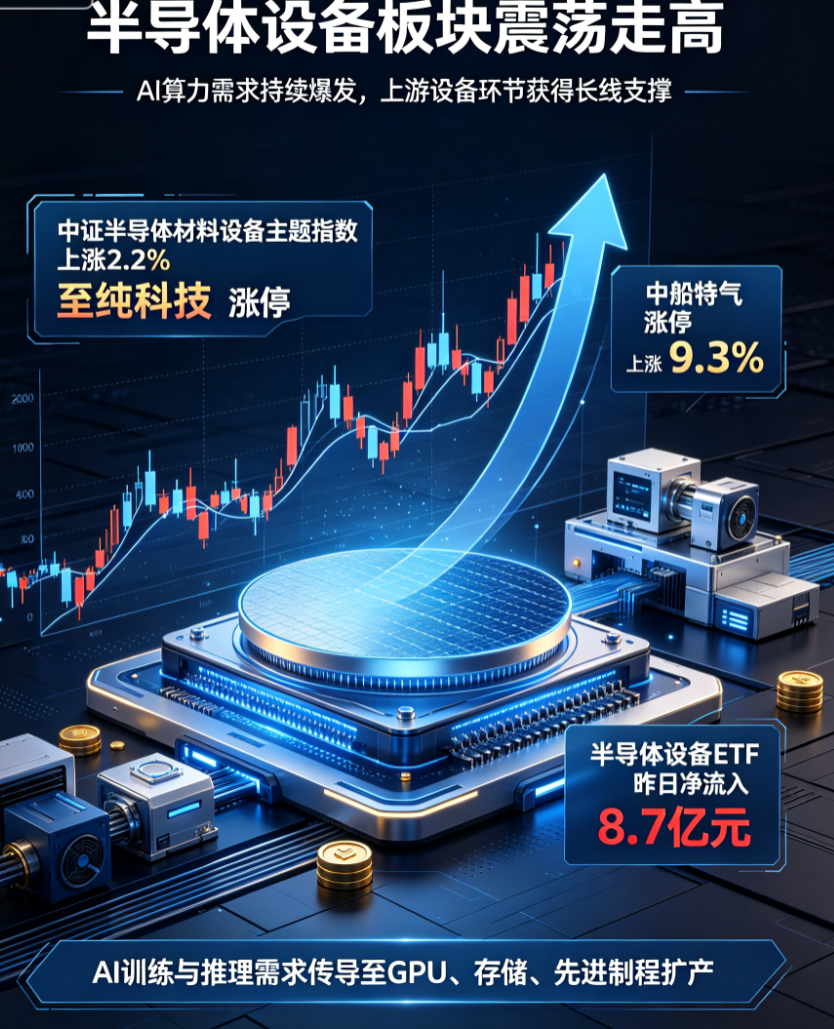
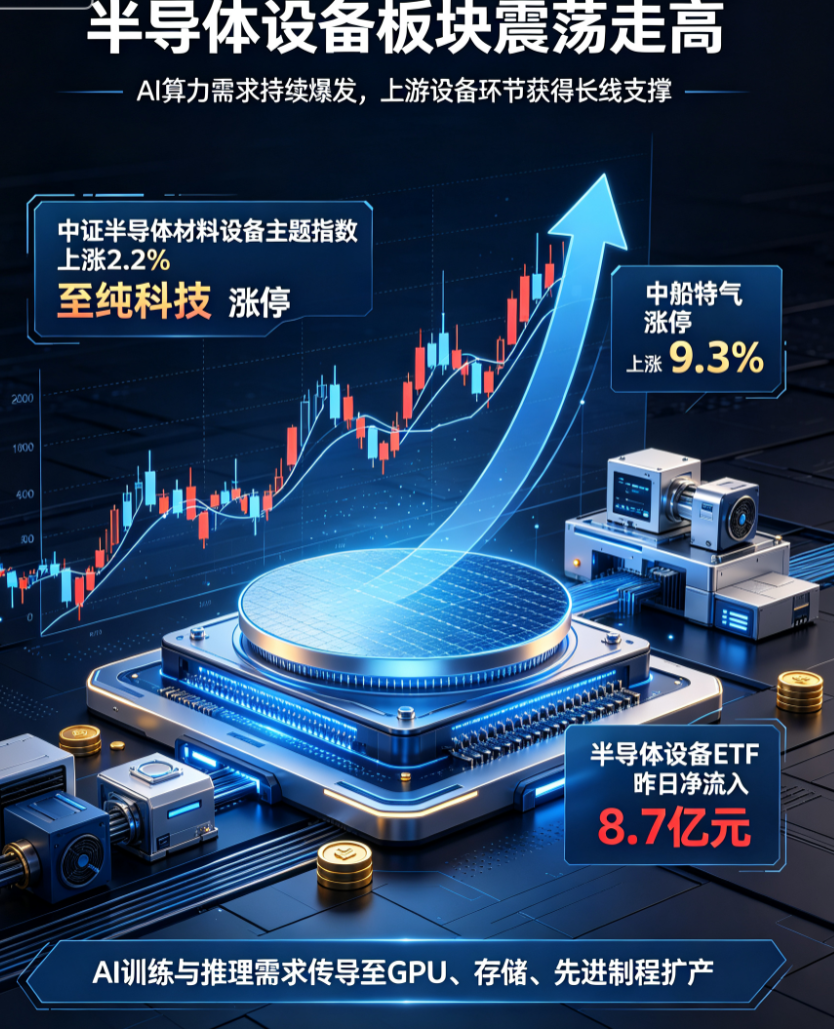
On July 24, 2024, the A-share market experienced a strong surge in the semiconductor equipment sector. The CSI Semiconductor Materials & Equipment Theme Index rose 2.2% in morning trading, with constituent stocks performing strongly. Zhichun Technology hit the daily limit up, and CSSC Special Gas also gained 9.3%. Meanwhile, the Semiconductor Equipment ETF (E Fund, 159558) recorded a net capital inflow of 8.7 billion yuan yesterday, indicating a significant increase in market attention to this sector.
Behind this market movement is the significant upward revision of AI accelerator market expectations by industry giant AMD. AMD's latest forecast shows that by 2030, the AI accelerator market will reach $1.4 trillion, while the traditional data center CPU market will also reach $220 billion. Overall, the computing market is expected to reach $2 trillion by 2030. This development not only injects strong momentum into the AI industry chain but also brings a long-term growth logic to the upstream semiconductor equipment segment.
AMD Raises Forecast: AI Computing Demand Continues to Surge
AMD's forecast upgrade is not unfounded. With the rapid development of generative AI, large language models (LLMs), and multimodal AI, the explosive growth in AI training and inference demand has become an industry consensus. From OpenAI's GPT series to Google's Gemini, and to domestic enterprises like Baichuan and Zhipu, the parameter scale and computational complexity of AI models are growing exponentially. All of this requires powerful computing support, and AI accelerators (such as GPUs, TPUs, etc.) are the core hardware foundation.
AMD pointed out that by 2030, the AI accelerator market will reach $1.4 trillion, implying a compound annual growth rate of about 50% over the next six years. This trend is not only reflected at the data center level but is also accelerating penetration into scenarios such as edge computing, autonomous driving, and the industrial internet. For example, Tesla's FSD (Full Self-Driving) system needs to process massive sensor data in real time, which relies on efficient AI chips and accelerators.
From an industry chain perspective, the growth in AI computing demand will ultimately transmit to the upstream semiconductor equipment segment. As market analysis points out, the expansion of GPU, AI chip, or memory chip production requires the procurement of advanced semiconductor equipment. Orders for core equipment such as etching machines, thin-film deposition equipment, cleaning equipment, and inspection equipment will directly benefit from the expansion of AI chip production lines. Therefore, AMD's upward revision is not only an optimistic judgment of the downstream AI market but also an indirect endorsement of the long-term prosperity of the upstream equipment industry.
Semiconductor Equipment: Direct Beneficiary of AI Computing Demand
Semiconductor equipment is the "heart" and "skeleton" of the entire chip manufacturing process. From wafer fabrication to packaging and testing, every step requires precision equipment support. The complexity of AI chips is far higher than that of traditional logic chips. For example, NVIDIA's H100 GPU requires the most advanced 5nm or more advanced processes, which places extremely high performance demands on etching, thin-film deposition, lithography, and other equipment.
The CSI Semiconductor Materials & Equipment Theme Index precisely focuses on this key segment. The index covers core areas such as semiconductor materials, equipment, and components, with constituent stocks covering sub-tracks of semiconductor manufacturing equipment like etching, thin-film deposition, cleaning, and inspection. Taking etching equipment as an example, it is used to precisely remove materials from wafers and is key to achieving tiny circuit patterns. As AI chips evolve toward smaller process nodes (e.g., 3nm, 2nm), the precision and efficiency requirements for etching equipment will continue to increase.
In addition, the expansion of memory chips also requires a large amount of equipment. Due to the sharp increase in AI model parameters, demand for high-bandwidth memory (HBM) has also experienced explosive growth. HBM manufacturing requires advanced packaging and testing equipment, bringing new growth points for equipment suppliers. Meanwhile, cleaning and inspection equipment are also key to ensuring chip yield; any mistake in any link could lead to huge economic losses. Therefore, the prosperity of the semiconductor equipment sector depends not only on the shipment volume of AI chips but is also closely related to the technological upgrading of the entire chip manufacturing industry.
ETF Fund Inflow: Market Recognition of Long-Term Logic
It is noteworthy that the Semiconductor Equipment ETF (E Fund, 159558) recorded a net capital inflow of 8.7 billion yuan yesterday. This reflects the market's consensus on the long-term investment value of this sector. As a passive investment tool, ETF fund inflows often represent institutional and retail investors' collective optimism about industry trends.
From a valuation perspective, after the correction in 2022, the current valuation of the semiconductor equipment sector is at a level below the historical median. With the continuous surge in AI computing demand and the promotion of domestic substitution policies, this sector is expected to see a dual recovery in earnings and valuation. In particular, the support from national-level industrial funds such as the Phase III of the Big Fund will provide capital and technical support for local semiconductor equipment companies, accelerating the increase in penetration of domestic equipment.
In addition, the competitive landscape of the global semiconductor equipment market is also changing. Although international giants such as ASML (Netherlands), Applied Materials (USA), and Tokyo Electron (Japan) still dominate, Chinese domestic companies like AMEC and NAURA are making technological breakthroughs in areas such as etching and thin-film deposition, gradually narrowing the gap with advanced international levels. This "import substitution" logic provides an additional margin of safety for investors in equipment ETFs.
CSI Semiconductor Materials & Equipment Theme Index: Precise Focus on Upstream Core
The design of the CSI Semiconductor Materials & Equipment Theme Index fully reflects its focus on the upstream of the semiconductor industry chain. The index's constituent stocks mainly include semiconductor materials, equipment, and components, covering key links from silicon wafers and photoresists to etching machines and testers. This precise stock selection logic ensures that the index can directly benefit from the expansion cycle of the semiconductor manufacturing industry.
For ordinary investors, directly investing in a single semiconductor equipment company may involve significant individual stock risk. However, allocating through the Semiconductor Equipment ETF (E Fund, 159558) not only diversifies risk but also captures the growth dividends of the entire industry. The ETF's feeder fund A/C (021893/021894) also provides a convenient participation channel for off-market investors. Whether it is large institutional funds or small and medium investors, they can achieve flexible allocation to the semiconductor equipment sector through this ETF.
Conclusion: Long-Term Opportunities in AI Upstream
Overall, the rise of the semiconductor equipment sector is not a flash in the pan but the result of multiple factors such as the explosion of AI computing demand, AMD's upward revision of expectations, and support from domestic substitution policies. As AI accelerates its penetration into scenarios such as edge computing, autonomous driving, and the industrial internet, the demand for semiconductor equipment will continue to heat up. Whether it is etching equipment, thin-film deposition equipment, or cleaning and inspection equipment, they will all play an irreplaceable role in the wave of AI chip expansion.
For investors, locking in the Semiconductor Equipment ETF (E Fund, 159558) or its CSI Semiconductor Materials & Equipment Theme Index may be an efficient way to capture this long-term opportunity. In the era of exponential growth in AI computing power, the allocation value of the semiconductor equipment sector deserves long-term attention.