Semiconductor Equipment: The Industrial Cornerstone Through Investment Fog
Keywords: Semiconductor Equipment, Capital Expenditure, Process Iteration, Domestic Substitution, ChangXin Memory Technologies
Introduction: Why Equipment, Not Chips?
If I had to pick a direction I favor more from the semiconductor sector at the current point, my answer is becoming clearer: not the generic 'chips', but semiconductor equipment.
This is not an emotional judgment, nor a simple bet on the four words 'domestic substitution', but a conclusion drawn from industry patterns, capital expenditure, technological evolution, and valuation structure. Many people's first reaction to semiconductors is wafer fabs, memory, GPUs, advanced processes, AI chips, as if only the design stage is most attractive and manufacturing is the hardest core. But if we lengthen the cycle and raise the perspective, we will find that what can truly traverse volatility while also having both growth certainty and industrial strategic value is often equipment.
The reason is simple. Chips are the result; equipment is the starting point. Chips are products; equipment is productivity. Chip prosperity depends on demand fluctuations, while equipment prosperity depends more on technological leaps and capital expenditure direction. And at this point in time, the latter logic is precisely more solid than the former.
Evolution of Semiconductor Investment Logic: From 'Storytelling' to 'Watching Capacity'
In the past few years, the market's understanding of semiconductors has gone through several stages. The first stage was driven by 'chip shortage', where everyone focused on supply-demand mismatch; whoever could ship was strong. The second stage was driven by 'self-sufficiency', where everyone looked at domestic substitution; whoever could secure a position was valuable. Now, the market is entering a third stage: returning to the true essence of the industry—who can support process iteration, who can undertake capital expenditure, and who can form irreplaceable capabilities in manufacturing.
At this point, the importance of semiconductor equipment becomes prominent.
Because no matter how the semiconductor industry changes, some things remain unchanged: to expand wafer fabs, buy equipment first; to upgrade process nodes, verify equipment first; to improve yield, rely on equipment and process coordination; to advance localization, the most difficult and valuable part is still the equipment sector.

Many people like to understand equipment as the 'tool supplier' of wafer fabs, which underestimates it. More precisely, equipment companies are the 'machine tools' of the semiconductor manufacturing system. Whether a country's semiconductor industry chain truly has a foundation is not about whether it can design a few high-end chips, but whether it has the ability to gradually build up the equipment, process, maintenance, and verification system required for large-scale manufacturing.
Triple Benefiting Logic of the Equipment Industry: Why Is It More Certain Than Chips?
If you break down the semiconductor industry, you will find that the profit logic of different segments varies greatly. Chip design companies, especially those related to consumer electronics, are often more affected by end demand. If mobile phones sell poorly, PCs are sluggish, and customers cut inventory, performance fluctuations will be very obvious. Wafer manufacturing companies are prone to capital intensity and cyclical fluctuations, heavy assets, high depreciation, high investment, and their profit elasticity is often eroded when the industry is in a downturn. The materials segment is also important, but many material categories are relatively more fragmented, with long certification cycles and often slower volume ramps.
Equipment is different. The core advantage of equipment is that it benefits from three lines simultaneously.
First line: industry capital expenditure. As long as wafer fabs are built, expanded, or upgraded, equipment procurement is indispensable. Whether logic, memory, power, or compound semiconductors, equipment is a definite beneficiary.
Second line: increase in process complexity. The more advanced and complex the process, the higher the requirements for equipment quantity, precision, stability, and repeatability. It's not that equipment is good because chips sell well, but that as processes become complex, the value of equipment itself increases.
Third line: domestic substitution and supply chain restructuring. In recent years, the global semiconductor supply chain is no longer a simple market competition logic, but has been superimposed with geopolitics, export restrictions, and industrial security logic. Previously, 'buying the best in the world' for equipment was the default option; now, 'whether you can buy, continue to buy, maintain locally, and verify independently' has become equally important. This change essentially raises the strategic premium of domestic equipment.
In other words, the equipment sector does not simply feed on industry prosperity; it feeds on the triple logic of 'industry prosperity + process upgrade + domestic substitution'. This is very rare in the A-share market and the STAR Market.
High Barriers and Long-Term Value of the Equipment Industry: From Verification Cycle to Scale Ramp
Many investors look at equipment and easily fall into a misunderstanding: treating it as a policy theme. In fact, the essence of equipment is precisely not a theme, but a high-barrier track rarely found in hard-tech manufacturing.
Why are barriers high? First, long R&D cycles. Equipment is not internet software; it cannot be iterated by a few people writing code. It involves multiple disciplines such as vacuum, plasma, heat treatment, precision mechanics, materials science, control systems, optics, electrical engineering, fluids, and process coordination, making it a typical complex engineering system.
Second, difficult customer verification. Equipment entering a wafer fab is not over after 'selling'; it goes through a very long cycle from introduction, verification, matching, ramp-up to mass production. Customers will not easily change equipment, because changing equipment means process restructuring, yield fluctuations, production line risks, and huge trial-and-error costs.
Third, once equipment breaks through, stickiness is strong. If an equipment manufacturer successfully enters the supply chain of a leading wafer fab and runs through key links, subsequent additional orders, same-platform replication, and process iteration upgrades will bring strong scalability. That is, this industry looks difficult, slow, and arduous in the early stage, but once it crosses the threshold, commercial value will gradually be released.
This is also why semiconductor equipment companies often share a common feature: in the early years, the market questioned 'why is profit not high', and in later years, it suddenly realized that 'it's not that it has no profitability, but it is in the verification period, introduction period, and investment period'.
For investors, the most valuable stage is often the inflection point from 'can it be made' to 'can it be scaled and replicated'. Many domestic equipment companies are currently at this stage.
Future Opportunities: Deepening of Capital Expenditure, Process Iteration, and Domestic Substitution
Wafer fab capital expenditure will not disappear, only shift structurally
Many people worry about semiconductor cycle fluctuations, thinking that as long as the industry declines, equipment has no opportunity. This view is only half right.
Indeed, equipment is a capital expenditure-sensitive industry, and it will be affected by order rhythm in the short term. But if you extend the time horizon, semiconductor equipment demand does not disappear linearly; rather, it redistributes according to technology routes, regional layouts, and product structures. That is, equipment demand may not always be a broad rise, but it is likely to be structurally strong. Whoever correctly positions themselves in terms of process, customers, and track will have opportunities.
Process iteration drives continuous increase in equipment value per fab
Previously, many people understood capacity expansion as building more fabs. But in the advanced manufacturing stage, what is more important is not just the 'number of fabs', but the equipment density, complexity, and single-machine value of a single fab are rising.
For example, in film deposition, etching, cleaning, metrology, inspection, etc., as processes become more refined, the importance of equipment is increasing. This applies to advanced processes as well as advanced packaging. In the future, wafer manufacturing is not just about 'who has a production line', but 'who has a more complex, more stable, and higher-yield process system', and the carrier of the process system is equipment.
This means that equipment companies do not necessarily have to wait for an industry volume explosion; as long as they can continuously increase market share in high-value segments, the growth space is still large.
Domestication enters deep water, competition logic switches from 'existence' to 'share increase'
In previous years, the market speculated on domestic substitution, mostly talking about 'from 0 to 1'; now, many equipment sub-segments are no longer concept verification, but are gradually moving toward 'from 1 to 10'. The meaning of these two is completely different. From 0 to 1, the market easily gives imagination; from 1 to 10, the market starts to look at orders, revenue, gross margin, customer structure, verification rhythm, and platform capabilities. This is actually a better stage. Because from an investment perspective, only when the industry moves from sentiment-driven to performance-driven will the scarcity of excellent companies truly manifest.
ChangXin Memory Technologies and Yangtze Memory Technologies: New Catalysts for the Equipment Sector
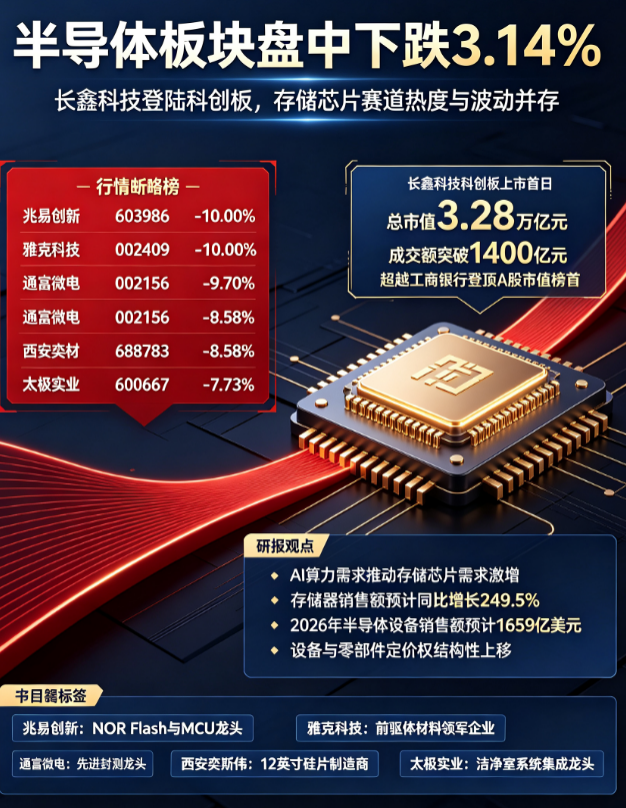
But if we switch perspective from the product side to the industry chain side, we will find that the more important significance of these two companies may not just be to bring activity to the 'memory concept', but to become important driving forces for the release of domestic semiconductor equipment demand and valuation reassessment.
First, once leading memory manufacturers complete capital market connection, financing and expansion capabilities are expected to be further enhanced, and equipment will be the most direct beneficiary.
Whether DRAM or NAND, they are essentially capital-intensive industries. The competition of memory manufacturers is not just about 'technological breakthroughs'; it is a systematic project that coordinates technology, process, capacity, yield, and capital expenditure. For leading manufacturers like ChangXin Memory Technologies and Yangtze Memory Technologies, if going public opens up broader financing channels, the market will usually naturally raise expectations for subsequent R&D investment, capacity expansion, and process upgrades.
In the semiconductor industry chain, the first to undertake such expectation changes are not necessarily chip prices or design companies, but equipment companies. Because once a wafer fab expands production, the first step is not shipping, but purchasing equipment, verifying equipment, and introducing equipment. That is, if the capital market reassesses the growth ceiling of ChangXin and Yangtze, the equipment sector is usually one of the most sensitive and first-responding directions.
Second, the significance of ChangXin Memory and Yangtze Memory is not just 'two more listed companies', but to provide domestic equipment with stronger local verification platforms and order carriers.
What do equipment companies fear most? Not a lack of products, but a lack of sufficiently high-quality customer scenarios for verification, iteration, and volume. For domestic semiconductor equipment, the significance of leading wafer fabs is never just 'contributing revenue'; more importantly, they constitute the core soil for technological progress and product maturity.
If ChangXin Memory Technologies and Yangtze Memory Technologies further accelerate production line construction and process iteration pace after capitalization, then for domestic equipment manufacturers, it is equivalent to having a stronger, more sustainable, and more systematic local verification platform. Many domestic equipment used to be stuck at the stage of 'able to make, but long verification cycle, slow introduction pace'. Once downstream leading customers have stronger expansion momentum, the introduction opportunities, trial opportunities, and volume opportunities for equipment manufacturers may all increase simultaneously.
This is especially important for equipment companies. Because the most valuable thing in the equipment industry is not one-time orders, but the continuous breakthrough path of 'entering core customers — completing process verification — replicating to more production lines — gradually expanding product categories'. The stronger ChangXin and Yangtze are, the easier it is for domestic equipment companies to move up along this path.
Third, once ChangXin Memory and Yangtze Memory go public, it may change the market's pricing method for the semiconductor equipment sector.
In the past, the A-share market often fell into two extremes when looking at semiconductors. Either it only focused on the high-elasticity stories of the design end, or it only regarded manufacturing and equipment as 'heavy asset, low imagination' supporting links. But if ChangXin Memory and Yangtze Memory enter the capital market, investors will more intuitively realize that what truly supports the in-depth development of China's semiconductor industry is not just chip sales, but the formation of the entire manufacturing system. And the core beneficiary behind the manufacturing system is equipment.
In other words, the listing expectations of ChangXin and Yangtze, to some extent, will shift market attention from 'short-term price increases of chip products' to 'long-term upgrade of manufacturing capabilities'. Once the market narrative switches from product prices to capacity construction, process upgrades, and industry chain self-sufficiency, the valuation anchor of equipment companies may change.
How to Select Truly Investable Companies from the Equipment Track?
Of course, it must be emphasized that being bullish on semiconductor equipment does not mean blindly buying equipment stocks. Because although the logic of this industry is good, differentiation will be very obvious. What is truly worth paying attention to is not the label 'equipment', but the following core indicators:
- Whether there is a technological moat in sub-segments: Whether independent R&D capabilities are formed in key areas such as etching, film deposition, cleaning, and metrology.
- Whether it has entered the supply chain of mainstream customers: Whether it can enter the verification lists of leading wafer fabs such as SMIC, Hua Hong Semiconductor, ChangXin Memory Technologies, and Yangtze Memory Technologies.
- Whether it has the ability to continuously iterate and expand product categories: Whether it can expand from a single equipment to a platform product matrix.
- Whether it has gradually switched from R&D logic to order logic: Whether revenue growth has moved away from the pure concept stage and entered a trackable performance realization period.
- Whether the current valuation has overdrawn too many long-term expectations: When market sentiment is high, be cautious about targets whose valuations have significantly outpaced fundamentals.
This is also why I am currently heavily invested in companies like NAURA and Changchuan Technology. They are not without risks, but at least they have relatively clear industry positions and trackable growth paths.
Conclusion: Betting on Equipment Is Betting on the Future of the Industry
At the end of the day, I am bullish on semiconductor equipment not because I am betting on a short-term rally, but because I am betting on three longer-term trends.
First, betting that China's semiconductor manufacturing capabilities will continue to improve. As long as manufacturing capabilities need to improve, equipment is an unavoidable underlying support.
Second, betting that industry competition will gradually shift from 'competing in design' to 'competing in manufacturing systems'. The real advantage in the future is not just point technology, but large-scale, stable, replicable, and iterable manufacturing capabilities. Equipment is the core grip of this capability.
Third, betting that the capital market will eventually reprice truly moated high-end manufacturing assets. Market sentiment sometimes likes the fastest stories, but long-term capital is more willing to pay for the hardest moats. Equipment belongs to the direction that may not look lively in the early stage, but may continuously raise the ceiling of cognition in the later stage.
Many tracks look sexier; equipment looks 'clumsier'. Many concepts are easier to burst out in the short term, while equipment often has to wait for verification, orders, and performance. But the more the tech investment gradually returns to rationality, the more I feel that what is truly worth heavily researching is precisely these less noisy directions.