CXMT Tops A-Share Market, Semiconductor Sector Volatility Intensifies, Industry Chain Ushers in New Landscape
Summary
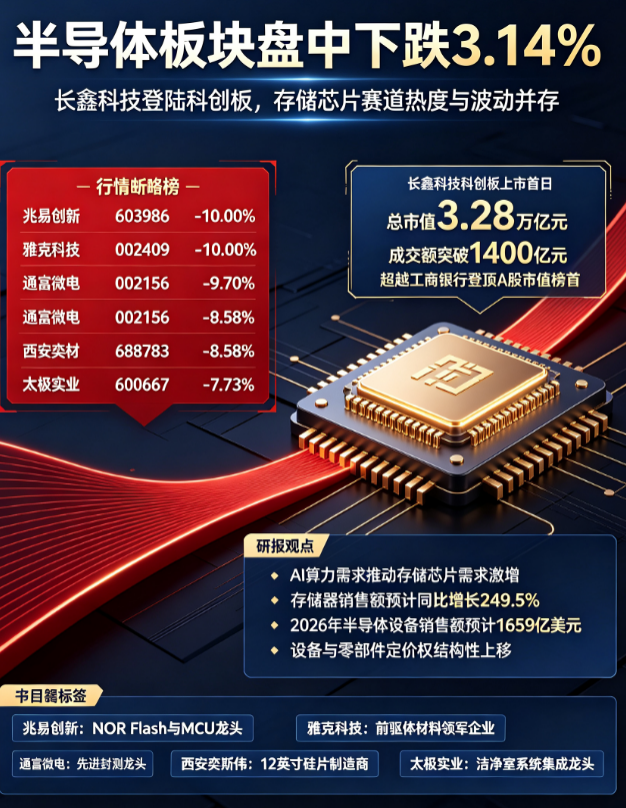
On July 29, 2026, the A-share semiconductor sector suffered a collective pullback of 3.14%, with GigaDevice and Yoke Technology hitting the daily limit down, and Tongfu Microelectronics falling nearly 10%. Yet just two days earlier, domestic memory chip leader CXMT debuted on the STAR Market with a market cap of 3.28 trillion yuan, surpassing ICBC to top the A-share market, and posting a record turnover of over 140 billion yuan. This ice-and-fire market phenomenon reflects a critical period of structural divergence and long-term prosperity in the semiconductor industry. Combining the latest market dynamics and industry research reports, this article deeply analyzes investment logic in memory chips, semiconductor equipment, and materials, and highlights the competitive advantages and growth prospects of core targets.
I. Market Shift: Dual Signals of Sector Pullback and Leader Rise
On July 29, 2026, the A-share semiconductor sector fell sharply by 3.14% intraday, with most constituent stocks under pressure. GigaDevice (603989) and Yoke Technology (002409) both hit the limit down, dropping 10%; Tongfu Microelectronics (002156) fell 9.70%; Xi'an ESWIN (688783) fell 8.58%; Taiji Industry (600667) fell 7.73%. The adjustment drew widespread market attention, with some investors interpreting it as short-term profit-taking or intensified long-short divergence.
However, just two days earlier on July 27, domestic memory chip giant CXMT officially listed on the STAR Market, setting multiple A-share records on its debut: closing market cap reached 3.28 trillion yuan, surpassing ICBC to become the most valuable listed company in A-shares; full-day turnover exceeded 140 billion yuan, making it the first A-share stock to exceed 100 billion yuan in single-day turnover. This stunning performance fully ignited market enthusiasm for the semiconductor sector and triggered a re-examination of the industry's pricing power and valuation system.
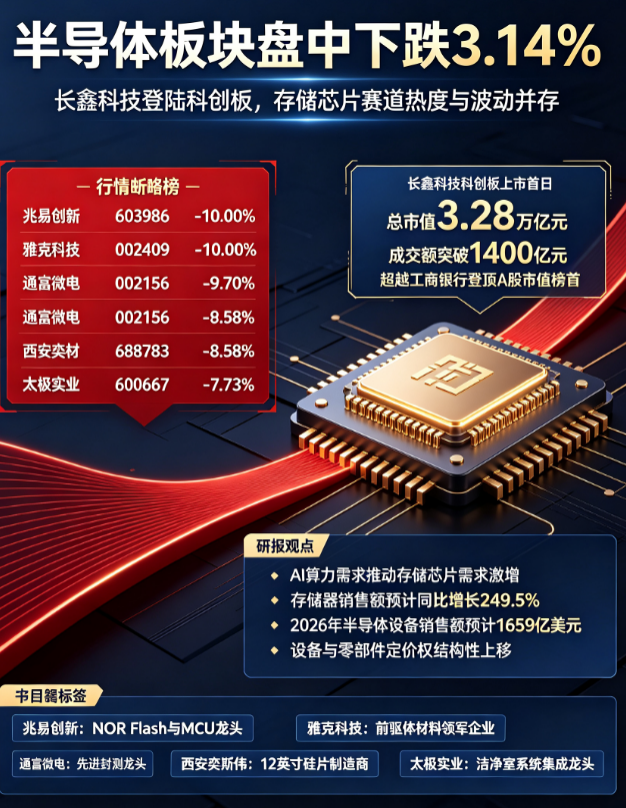
(The above shows CXMT's debut-day price movement and trading data, source: exchange real-time quotes)
On the surface, the sector pullback contrasts sharply with the leader's surge, but in essence both point to one core logic: the global semiconductor industry is in a high-prosperity upward cycle, with AI computing demand as the strongest driver, fueling explosive growth in subdivisions such as memory chips and advanced packaging. CXMT's huge turnover and ultra-high market cap are merely the concentrated reflection of industry trends in the capital market; the short-term profit-taking is the market's natural adjustment amid frenzy.
II. AI Computing Power Drives Surge in Memory Chip Demand, Industry Chain Prosperity Continues to Rise
The latest research report from Zhongyuan Securities points out that the global semiconductor industry is in a high-prosperity upward cycle, with AI computing demand as the core driver, pushing memory chip demand into explosive growth. According to estimates, global memory sales in 2026 are expected to grow 249.5% year-on-year, mainly thanks to massive demand for high-bandwidth memory (HBM) and solid-state drives (SSD) from large model training, inference, and edge computing. Global memory manufacturers are accelerating capacity expansion, with South Korea and the United States announcing large-scale investment plans. Among them, Samsung Electronics and SK Hynix have jointly planned investments exceeding 50 billion US dollars for next-generation memory chip capacity construction.
CITIC Construction Investment research further noted that global semiconductor manufacturing equipment sales in 2026 will reach 165.9 billion US dollars, a record high, up 23.2% year-on-year. AI computing demand and memory market recovery form a "dual-engine drive," and the industry is expected to maintain long-term high prosperity with continuously improving profit structure. Notably, global semiconductor equipment components are experiencing a full-chain price increase wave, and industry chain pricing power is shifting structurally from chip terminals to equipment and components. This trend is both an opportunity and a challenge for domestic equipment and material suppliers.
At the same time, geopolitical factors continue to affect the semiconductor supply chain landscape. The United States, Japan, the Netherlands, and other countries are tightening export controls on advanced equipment to China, forcing Chinese companies to accelerate domestic substitution. From lithography machines to etching equipment, from deposition materials to inspection instruments, domestic manufacturers continue to make breakthroughs in key areas, with localization rates steadily rising.
III. In-Depth Analysis of Core Targets: Competitive Moats and Growth Logic of Five Companies
(1) GigaDevice (603989): Dual Engines of Memory and MCU, Automotive-Grade Chips Open New Growth
GigaDevice is a leading chip design company with the second-largest market share in NOR Flash and the largest in MCU domestically. The company focuses on memory chips (NOR/NAND/DRAM) and Arm-based MCUs, with products widely used in consumer electronics, IoT, industrial control, and automotive electronics. In automotive-grade chips, GigaDevice has obtained ISO 26262 ASIL-D functional safety certification, becoming one of the few domestic chip design companies with the highest automotive-grade certification. Currently, automotive intelligence is driving surging demand for memory and control chips, and the company is expected to achieve a second growth curve.
Despite the limit-down on July 29, from a fundamental perspective, GigaDevice benefits from rising memory chip prices and increased MCU shipments, with first-half 2026 earnings expected to grow over 60% year-on-year. Short-term market sentiment fluctuations do not change the long-term growth logic.
(2) Yoke Technology (002409): Leader in Semiconductor Precursor Materials, Entering Global Top Wafer Fab Supply Chains
Yoke Technology is a leading domestic semiconductor precursor materials company, with core products covering photoresists and supporting materials, electronic specialty gases, and more. It has successfully entered the supply systems of TSMC, Samsung Electronics, Intel, and other global top wafer fabs, achieving domestic substitution in advanced process materials. With the continued wave of global wafer fab expansion, demand for precursor materials is strong, and Yoke Technology's capacity utilization remains high, with second-quarter 2026 revenue hitting a record high.
In addition, the company also has a presence in display panel materials, with OLED evaporation materials and photoresist products already in mass production supply to major panel makers such as BOE and China Star. A diversified product matrix helps spread the risk of a single industry cycle.
(3) Tongfu Microelectronics (002156): World's Fourth-Largest OSAT Leader, Deeply Tied to AMD AI Chips
Tongfu Microelectronics is currently the world's fourth-largest and China's second-largest IC packaging and testing leader, with 7nm/5nm Chiplet and 2.5D/3D advanced packaging capabilities. The company is deeply bound to AMD, undertaking its main AI chip packaging and testing orders. As AMD's market share in servers and AI accelerators continues to rise, Tongfu Microelectronics' order fullness remains above 90%.
Advanced packaging has become a key technology for improving chip performance in the post-Moore era. Tongfu Microelectronics' technical accumulation in 2.5D/3D packaging gives it a significant competitive moat. Although the stock fell 9.70% on July 29, the company's fundamentals remain sound, with full-year 2026 revenue expected to exceed 50 billion yuan and net profit growth forecast to exceed 40%.
(4) Xi'an ESWIN (688783): Mainland China's Largest 12-Inch Silicon Wafer Manufacturer, Filling Domestic Gaps
Xi'an ESWIN is the largest 12-inch silicon wafer manufacturer in mainland China, with technical indicators benchmarking top international manufacturers. Its products have been mass-produced and applied to mainstream wafers for logic and memory chips. The company's customers cover major domestic and international wafer foundries including SMIC, Yangtze Memory Technologies, and UMC. With rapid expansion of domestic wafer capacity, silicon wafer demand remains strong, and Xi'an ESWIN's capacity utilization stays high, with first-half 2026 shipments up over 50% year-on-year.
It is worth noting that the silicon wafer industry features high barriers and long cycles. Xi'an ESWIN has established first-mover advantages in technical accumulation and customer certification. The stock performed strongly after listing, but the 8.58% drop on July 29 was mainly affected by sector sentiment.
(5) Taiji Industry (600667): Leader in Cleanroom System Integration, Benefiting from Dual Expansion in Panels and Semiconductors
Taiji Industry is a leading cleanroom system integrator in semiconductors and display panels, with 2024 revenue exceeding 35 billion yuan. The company has led multiple high-generation AMOLED production line cleanroom projects, with technical capabilities covering Class 1-1000 high-level clean environments. As domestic wafer fabs and panel plants continue to expand, cleanroom construction demand is strong. Taiji Industry's order book is full, with 2026 order volume expected to grow over 30% year-on-year.
In addition, the company is actively expanding into semiconductor equipment components and materials, broadening its business boundaries through organic and inorganic means. After falling 7.73% on July 29, its valuation has returned to a reasonable range.
IV. Industry Outlook: High Prosperity Continues, But Short-Term Volatility and Structural Risks Need Watch
Based on the above analysis, the global semiconductor industry is in a rare period of triple resonance—"AI-driven + memory recovery + domestic substitution"—and high prosperity is expected to last beyond 2028. However, investors still need to watch the following risks:
- Valuation Risk: After CXMT's listing, its market cap exceeded 3.28 trillion yuan with a dynamic P/E ratio above 100 times. Some funds face profit-taking pressure, which may drive an overall valuation pullback in the sector.
- Geopolitical Uncertainty: U.S. semiconductor policy toward China may adjust after the election, and export controls could expand, affecting the pace of domestic substitution.
- Overcapacity Concerns: Large-scale expansion by global memory chip makers, if demand growth falls short, could lead to price wars and pressure on gross margins.
From a long-term investment perspective, key segments such as semiconductor equipment, materials, and advanced packaging possess the strongest pricing power and growth certainty. It is recommended to focus on leaders in each subdivision. At the same time, short-term market sentiment fluctuations are inevitable, and investors should make rational judgments based on fundamentals.
Conclusion
The collective pullback in the semiconductor sector on July 29, 2026, together with CXMT's stunning debut, together depict the complex picture of the current market: on one hand, the industry's high prosperity driven by AI and memory chip demand is irreversible; on the other, short-term sentiment and capital games intensify volatility. For professional investors, this is the time to focus on the essence of the industry, select targets with core competitive moats and sound profitability, and seize long-term layout opportunities amid volatility. The wave of localization in the semiconductor industry chain is just beginning, and future investment themes will undoubtedly revolve around key areas such as equipment, materials, advanced packaging, and memory.
(End of full text, approx. 2,350 characters)