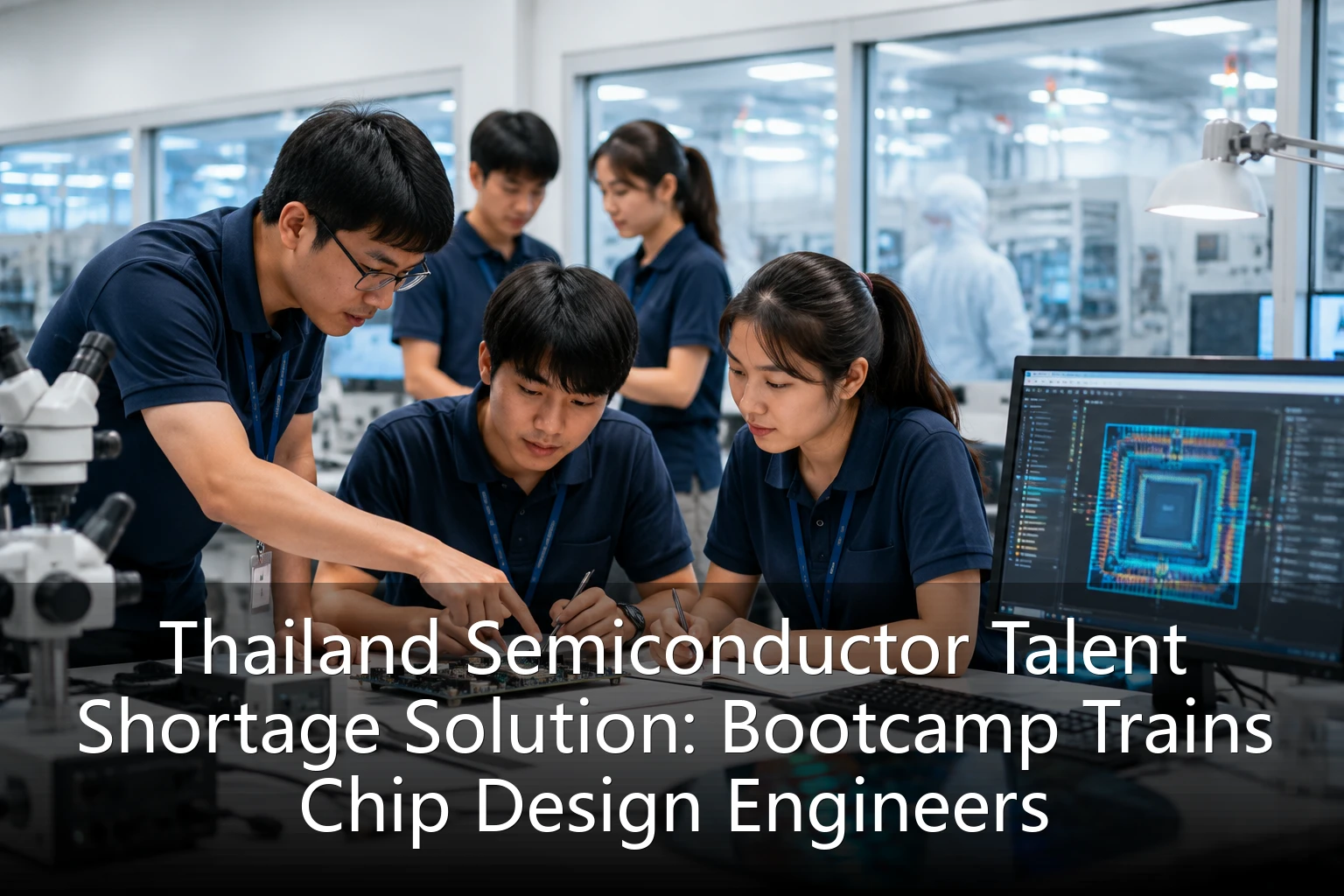
As the global semiconductor supply chain restructures, Thailand is actively developing its local semiconductor manufacturing and packaging/testing industry, but a shortage of technical talent has become a major bottleneck. To address this, the Thailand Board of Investment (BOI), in collaboration with domestic and international foundries and universities, launched the 'Semiconductor Bootcamp' in July 2026. The first session started in the EEC special economic zone east of Bangkok, aiming to quickly cultivate chip design and process engineers with practical skills.
Hands-On Curriculum Targets Industry Pain Points
The Semiconductor Bootcamp differs from traditional university education by emphasizing 'learning by doing.' The curriculum covers full-chain skills from circuit design and simulation verification to wafer manufacturing, packaging, and testing. Trainees must complete at least two real projects within 12 weeks: one designing a low-power MCU chip for IoT, and another participating in advanced packaging process debugging. Upon completion, they must pass a hands-on assessment in a simulated wafer fab (Mini-Fab).
The director of the Thailand Microelectronics Center (TMEC), one of the organizers, stated: 'Previously, companies needed to retrain new hires for six months; now bootcamp graduates are ready to work directly.' It is reported that 80% of the first 50 trainees have received pre-offers from local semiconductor companies, with starting salaries 15% higher than average engineers.
BOI Policy Support: Goal of 2,000 Engineers in 3 Years
The BOI Secretary-General announced at the opening ceremony that each trainee will receive a tuition subsidy of up to 50,000 THB, and participating companies will provide internship allowances. BOI has set a goal to train 2,000 internationally competitive semiconductor engineers in three years to support Thailand's under-construction 12-inch wafer fab and five advanced packaging/testing facilities. These production lines are expected to be fully operational by 2028, creating over 15,000 technical positions.
The Secretary-General stressed: 'Talent is the key to semiconductor investment. We must not only attract foreign companies to set up factories but also cultivate local engineers to ensure sustainable industry development.'
Strong Industry Feedback; Course Expansion to Southeast Asia
Participating companies include Taiwan's ASE, US Intel (Thailand packaging/testing plant), and Singapore's Chartered Semiconductor. ASE Thailand's HR head stated that the bootcamp directly shortens ramp-up time for new hires and reduces recruitment costs. He revealed that ASE has decided to sponsor the second session and open some production lines as teaching venues.
Due to enthusiastic response, the organizers plan to run three sessions by end of 2026 and extend the curriculum to embedded systems and AI chip design. Meanwhile, semiconductor associations from Vietnam, Malaysia, and other countries have expressed interest in cooperation, potentially replicating the model to other ASEAN nations.
Challenges and Outlook
Although the bootcamp temporarily eases the talent gap, the industry remains concerned about long-term supply shortages. The Thai Higher Education Commission is reviewing university microelectronics curricula, recommending more project-based learning and establishing credit transfer mechanisms with the bootcamp. Moreover, the source of instructors is an issue; currently relying on retired fab experts, local trainers need to be developed in the future.
- Faculty Optimization: TMEC plans to collaborate with Singapore's Nanyang Technological University to establish a semiconductor trainer training center.
- Equipment Upgrade: The training equipment used in the bootcamp is decommissioned 6-inch lines, still lagging behind 12-inch fabs; subsequent efforts need to procure second-hand advanced equipment.
- International Certification: The goal is to establish Southeast Asia's first semiconductor competency certification system by 2027, making completion certificates recognized by the international industry.
Overall, the Thailand Semiconductor Bootcamp is in its nascent stage, offering a feasible shortcut for regional semiconductor talent cultivation. With more resource investment and deepening cross-border collaboration, Thailand has the opportunity to become a cradle of semiconductor talent in Southeast Asia, attracting more upstream, midstream, and downstream investments.
For young people aspiring to excel in the semiconductor industry, joining the bootcamp may be the most direct path in recent years. For investors, the improvement in talent supply will be a key indicator for assessing Thailand's long-term semiconductor competitiveness.