Long-Term Logic of Semiconductor Industry: From Capital Inflows to Technology-Driven Structural Opportunities
Keywords
Semiconductor, Capital Inflow, AI-driven, Domestic Substitution, Equipment Investment, Memory Chips
Introduction
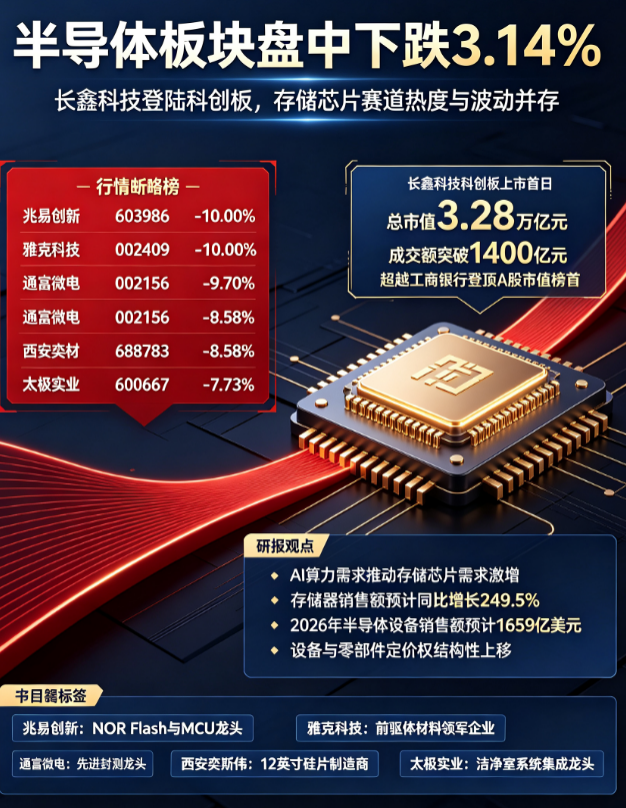
In early July 2026, the global semiconductor sector experienced short-term volatility, but the enthusiasm for capital deployment has not cooled. According to Wind statistics, as of July 10, semiconductor-themed ETFs saw a net inflow of over 100 billion RMB in the past 15 trading days, demonstrating a typical pattern of "buying on dips." This is not blind bottom-fishing but a consensus confirmation of the medium- to long-term mainline of the semiconductor industry. Driven by the dual engines of the AI wave and domestic substitution, the semiconductor industry is shifting from cyclical fluctuations to structural growth, and its investment logic is becoming increasingly clear.
Capital Flows Against the Trend Reveal Market Consensus
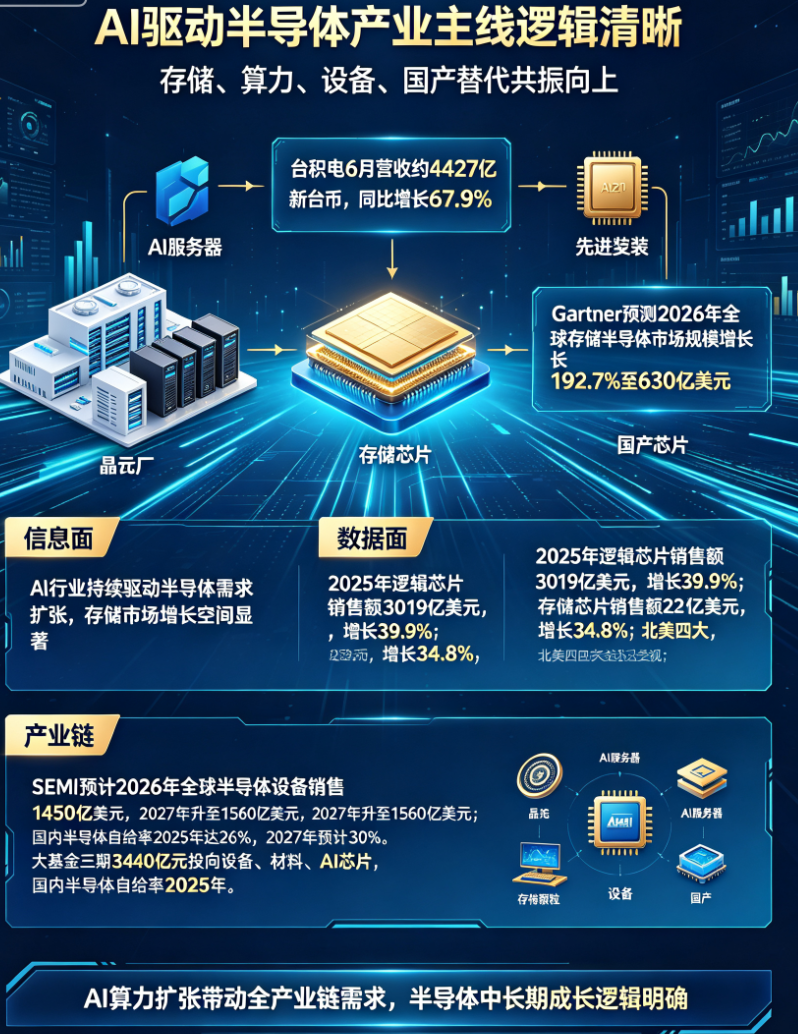
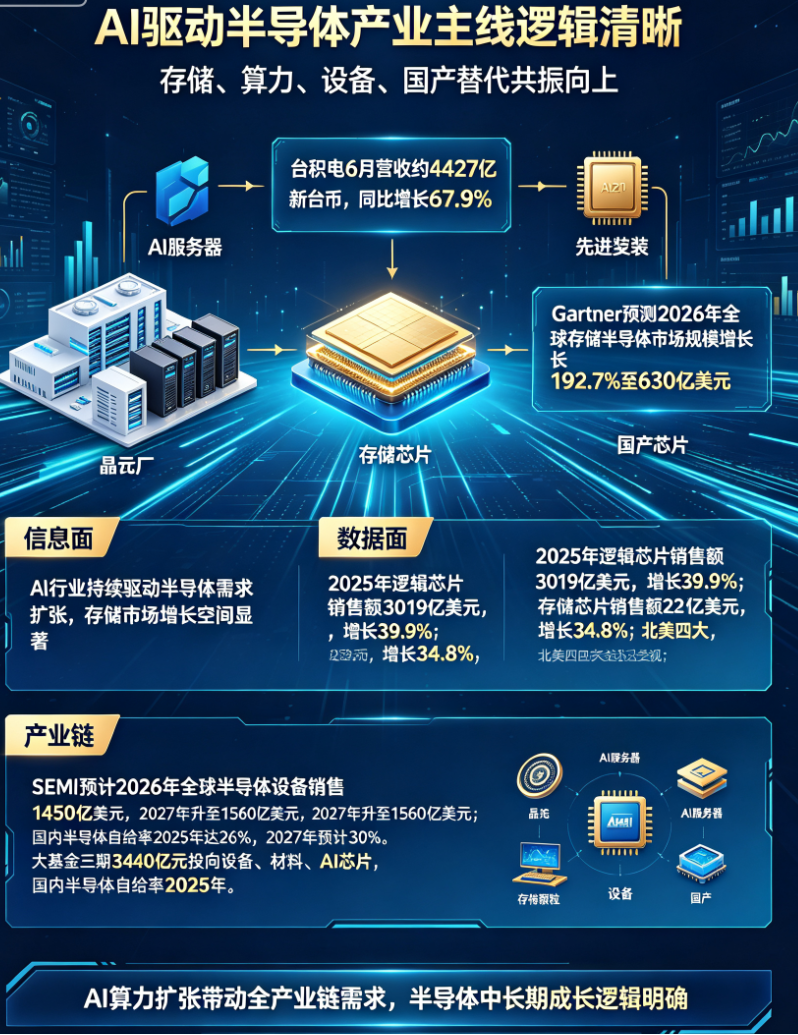
The recent volatility in the semiconductor sector mainly resulted from short-term profit-taking and macroeconomic sentiment swings. However, capital flows reveal the true attitude of institutional investors: they view this pullback as an opportunity to position themselves. From real economy data, TSMC's June revenue was approximately NT$442.7 billion, up 67.9% year-on-year, directly reflecting the explosive growth in AI chip demand. Gartner forecasts that the global memory semiconductor market will grow 192.7% in 2026 to $633 billion. Such growth is not just a cyclical recovery but a structural leap driven by AI training and inference demand. Capital dares to increase positions amid volatility because they see the certainty of AI-driven semiconductor demand—this is not a short-term theme but a multi-year industry trend.
Growth Drivers Behind the Data: From Cloud to Edge
From a data perspective, the growth trend is equally clear. In 2025, logic chip sales are expected to reach $301.9 billion (up 39.9% YoY), and memory chips $223.1 billion (up 34.8% YoY). The four major North American cloud service providers (Amazon, Microsoft, Google, Meta) are expected to invest $600 billion in AI infrastructure in 2026, which will directly translate into orders for GPUs, HBM memory, and advanced logic chips. Data centers' share of global semiconductor revenue is rapidly approaching 50%, meaning the core growth driver of the semiconductor industry has shifted from consumer electronics to AI computing.
Structural changes in the memory segment are particularly prominent. AI servers require 8 to 10 times the memory of traditional servers, and HBM's share of the DRAM market has risen from single digits in 2023 to 23% in 2026, with sales exceeding $30 billion. The rapid ramp-up of HBM is not only volume growth but also price appreciation—its unit price is much higher than traditional DRAM, significantly improving the overall profitability of memory chips. This explains why the memory chip market can nearly double in size in a short period.
Dual Support from the Supply Chain and Domestic Substitution
From a supply chain perspective, equipment-side demand is equally strong. SEMI forecasts global semiconductor equipment sales will reach $145 billion in 2026 and further $156 billion in 2027, mainly driven by AI-related advanced logic processes, memory, and advanced packaging investments. Advanced packaging (e.g., CoWoS) is becoming a key link to enhance chip performance, with giants like TSMC, Samsung, and Intel expanding capacity, leading to rising equipment procurement.
In mainland China, the logic of domestic substitution is shifting from policy-driven to market-driven. The domestic semiconductor self-sufficiency rate has risen from 10% in 2018 to 26% in 2025, and is expected to reach 30% by 2027. While there is still a gap to full autonomy, the progress is significant. The third phase of the Big Fund, with a scale of 344 billion RMB, is precisely invested in core areas such as equipment, materials, and AI chips, providing long-term capital support for domestic substitution. For investors, this means that in areas like wafer manufacturing, packaging and testing, and key materials, domestic substitution targets possess growth potential above the industry average.
Conclusion
In summary, the semiconductor industry is in a structural growth cycle driven by AI. The core logic lies in: continuous expansion of AI infrastructure investment, explosive growth in memory chip demand, and technological iteration of advanced processes and advanced packaging. Short-term volatility does not change the long-term trend; contrarian capital inflows endorse this judgment. For investors, the focus should be on: AI chip design, HBM and high-end memory, advanced packaging equipment, and domestic substitution leaders. Under the dual effects of technological iteration and capital investment, these four areas are expected to deliver excess returns over the next 3 to 5 years.
The marathon of the semiconductor industry has just begun. When market sentiment wavers due to short-term fluctuations, only those who truly understand the structural changes in the industry can seize the most certain growth dividends of this era.