AI-Driven Semiconductor Equipment Market Ushers in Five Consecutive Years of Growth: SEMI Forecasts Total Sales of $229.5 Billion by 2028
\nAbstract
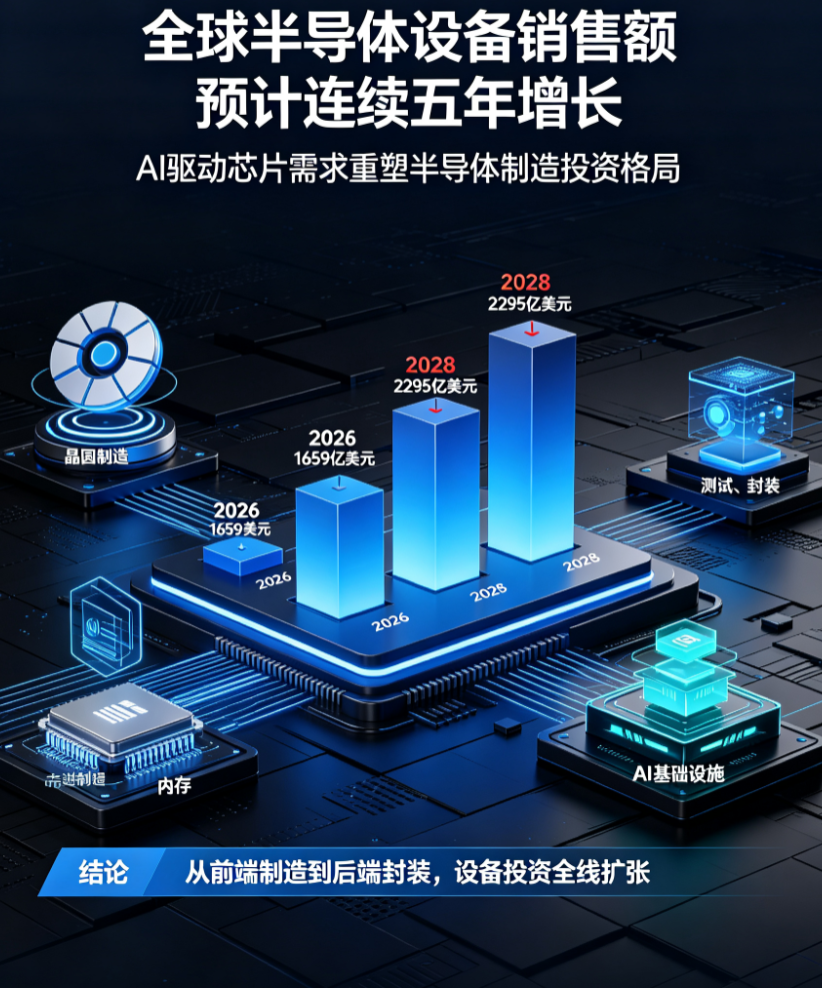
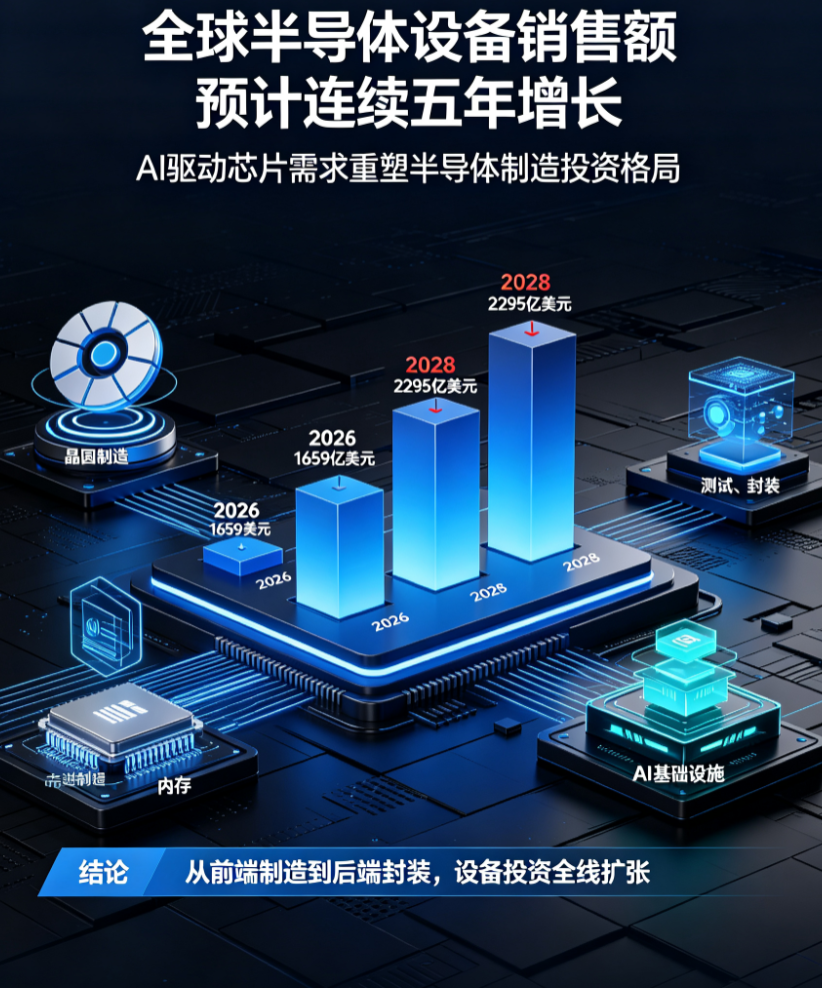
\nThe Global Semiconductor Association (SEMI) recently released its "Mid-Year Semiconductor Equipment Market Forecast - OEM Perspective" report, indicating that the explosive growth of AI demand is reshaping investment patterns in semiconductor manufacturing. It forecasts that total global sales of semiconductor manufacturing equipment will grow for five consecutive years, reaching an astonishing $229.5 billion by 2028. This article delves into the driving factors behind this trend, analyzing growth momentum in wafer manufacturing, backend equipment, logic and memory markets, and examines investment prospects in Mainland China, Taiwan, and South Korea from a regional perspective.
\nIntroduction: AI — The New Engine of the Semiconductor Equipment Market
\nDriven by the dual forces of digital transformation and rapid iteration of AI technologies, the semiconductor industry is undergoing unprecedented structural change. The "Mid-Year Semiconductor Equipment Market Forecast - OEM Perspective" report released by SEMI on Tuesday paints an exciting growth blueprint for the industry. It predicts that global semiconductor manufacturing equipment sales will enter a five-year consecutive growth cycle, rising from a record level in 2025 to $229.5 billion by 2028.
\nThe core driving force behind this growth is undoubtedly the widespread application of AI technology. From data center AI infrastructure construction to mass production of advanced logic chips, breakthroughs in memory technology, and innovations in backend packaging technology, AI is fundamentally changing the investment logic of semiconductor manufacturing.
\n![AI-Driven Semiconductor Equipment Market Growth Trend Chart]()
\nRecord-Breaking 2025: A Historical High for the Equipment Market
\nAccording to the SEMI report, total global sales of semiconductor manufacturing equipment by original equipment manufacturers (OEMs) will reach a record $165.9 billion in 2025, up 23.2% year-over-year. This remarkable growth not only reflects strong market demand but also indicates that the semiconductor industry is entering a new growth cycle centered on AI.
\nSEMI President and CEO Ajit Manocha pointed out in the report: "AI is accelerating the demand for more powerful and efficient chips, thereby driving significant growth in semiconductor equipment market investment." This view accurately captures the essence of current industry changes: AI is no longer just a technological innovation at the application level, but is reshaping the investment logic and growth path of the semiconductor industry across the entire chain from chip design, manufacturing to packaging and testing.
\nWafer Manufacturing Equipment: Structural Opportunities Amid Steady Growth
\nStrong Performance of Wafer Processing and Mask Markets
\nWithin the overall equipment market, the wafer manufacturing equipment segment stands out particularly. This segment, covering wafer processing, mask\/reticle, and fab equipment, already achieved a sales record of $116.9 billion last year. According to SEMI's latest forecast, this segment will grow by 23.1% in 2026 to $143.9 billion, a significant upward revision from SEMI's previous forecast.
\n![Wafer Manufacturing Equipment Sales Growth Trend Chart]()
\nWith major fabs worldwide accelerating capacity expansion and technology migration, demand for wafer manufacturing equipment continues to heat up. SEMI predicts that sales in this segment will grow by 21.8% in 2027 and further by 14.1% in 2028, surpassing the $200 billion mark. This unprecedented growth level reflects strong demand from end applications such as AI, high-performance computing (HPC), and the Internet of Things, driving accelerated transition from mature to advanced process nodes.
\nDual Drive of Technology Migration and Capacity Expansion
\nCurrently, major global fabs are in a critical period of technology migration. Giants like TSMC, Samsung, and Intel are ramping up investments in advanced processes, from 7nm, 5nm to 3nm, and even preparation for 2nm mass production is underway. This technology evolution trend generates huge demand for core wafer manufacturing equipment such as high-end lithography machines, etching equipment, and deposition equipment.
\nMeanwhile, geopolitical factors are driving regional capacity expansion. Governments are introducing semiconductor subsidy policies to encourage local fab construction for supply chain security. Policies such as the U.S. CHIPS and Science Act, the European Union's European Chips Act, and Japan's semiconductor revitalization plan are injecting new growth momentum into the wafer manufacturing equipment market.
\nBackend Equipment Market: Technological Revolution in Testing and Packaging
\nTest Equipment: Quality Guardian in the AI Era
\nThe prosperity of wafer manufacturing equipment is not an isolated phenomenon. The backend equipment market, especially test equipment and packaging equipment, is also showing vibrant development. The SEMI report predicts that semiconductor test equipment sales will surge 55.3% in 2025 and continue to grow by 31.0% in 2026, reaching $15.3 billion. This figure marks a significant upward revision from SEMI's previous forecast for end of 2025, reflecting a notable change in market judgment on test equipment demand growth.
\nBy 2028, the test equipment market is forecast to further grow to $20.8 billion. Behind this growth lies the higher requirements for test precision and efficiency posed by AI chips. As chip design becomes increasingly complex, especially with the deepening application of high-bandwidth memory and heterogeneous integration architectures in AI accelerators, the importance of the testing phase continues to rise.
\nPackaging Equipment: Technological Breakthroughs in the Heterogeneous Integration Era
\nOn a more granular level, the packaging equipment market is also performing well. SEMI expects packaging equipment sales to grow by 20.8% in 2025 and then by 9.6% in 2026, reaching $6.7 billion. This forecast is broadly consistent with previous predictions, indicating a stable growth trend in the packaging equipment market.
\nSEMI predicts this growth momentum will continue until 2028, driven by factors including increasing chip complexity, widespread adoption of advanced heterogeneous packaging technologies, and rising demands for performance and reliability. In particular, the need to integrate high-bandwidth memory (HBM) with logic chips in AI chips is driving rapid development of 2.5D and 3D packaging technologies.
\n![Packaging Equipment Technology Evolution Diagram]()
\nApplication Areas and Regional Distribution: Logic, Memory, and Three Core Markets
\n2nm Process: A New Milestone for Logic Chip Equipment Market
\nFrom an application perspective, equipment investment in logic chip and memory markets is showing different growth paths. As 2nm processes enter mass production, SEMI estimates that sales of equipment for foundry and central processing unit (CPU) manufacturing will grow by 18.9% in 2025, reaching $78 billion. This growth trend is expected to continue, with sales forecast to exceed $100 billion by 2028.
\nCommercialization of the 2nm process not only means higher-performance chip products but also represents a new era in semiconductor manufacturing technology. The huge investments by foundries such as TSMC and Samsung in 2nm processes are translating into actual demand for the equipment market.
\nMemory Market: Infrastructure for the AI Era
\nThe memory market is also performing strongly this year. SEMI forecasts that memory equipment sales will grow by 39% in 2025 to $13.9 billion, and further climb to $20.8 billion by 2028. The strong demand for high-bandwidth memory (HBM) and large-capacity storage devices in AI training and inference is the core driver of memory equipment investment growth.
\nRegional Landscape: Mainland China Leads, Taiwan and South Korea Follow
\nBy region, Mainland China, Taiwan, and South Korea will be the top three regions in equipment spending, with Mainland China maintaining the lead. This pattern reflects both Mainland China's sustained efforts in semiconductor self-reliance and the huge appeal of its vast domestic market.
\nTaiwan will benefit mainly from frontier capacity construction in AI and high-performance computing (HPC). TSMC's leading position in global advanced processes makes it a core node for AI chip manufacturing, naturally driving significant equipment investment in the Taiwan region.
\nSouth Korea will increase its investment in memory. Samsung and SK Hynix, as leaders in the global memory market, will continue to drive South Korea's equipment spending through their technological advantages and capacity expansion plans in HBM.
\nConclusion: A New Paradigm for Semiconductor Equipment Investment in the AI Era
\nSEMI's latest forecast clearly indicates that AI is becoming the strongest growth engine for the semiconductor equipment market. From wafer manufacturing to backend packaging and testing, from logic chips to memory, from North America to Asia, AI-driven investment is reshaping every aspect of semiconductor manufacturing comprehensively.
\nNotably, this growth trend is not a short-term cyclical fluctuation but reflects the profound structural impact of AI on the semiconductor industry. As AI moves from labs to commercial applications, from cloud to edge, from large data centers to end devices, demand for specialized chips will continue to expand. This means the growth potential of the semiconductor equipment market is far from peaking.
\nFor investors and industry participants, grasping the three core trends of semiconductor equipment investment in the AI era — advanced process technology migration, heterogeneous packaging technology breakthroughs, and regional capacity expansion — will be key to success in this wave of growth.
\nBehind SEMI's optimistic forecast lies a new semiconductor era driven by AI, where technology and capital deeply integrate. This era is bringing unprecedented opportunities and challenges to the entire industry chain.