Under the AI Computing Wave, Semiconductor Equipment and Optical Communication Links Enter a Golden Expansion Period
Keywords: Semiconductor Expansion, Advanced Packaging, Silicon Photonics, AI Computing Power, Equipment Spending, Optical Communication
Introduction
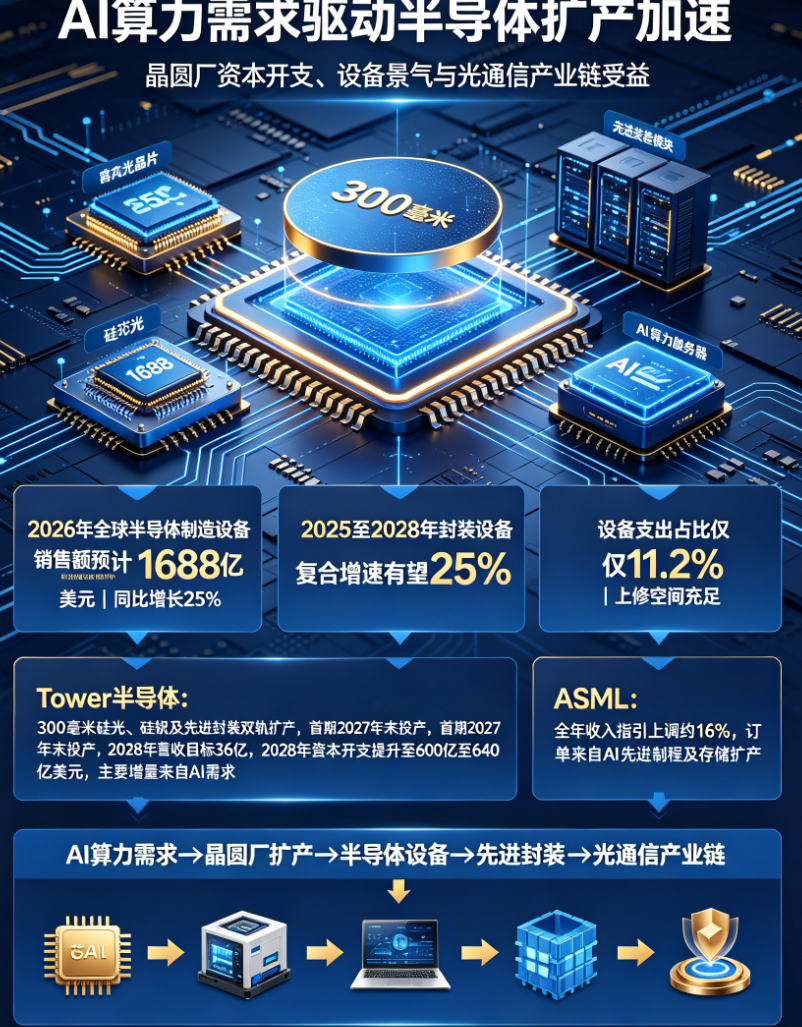
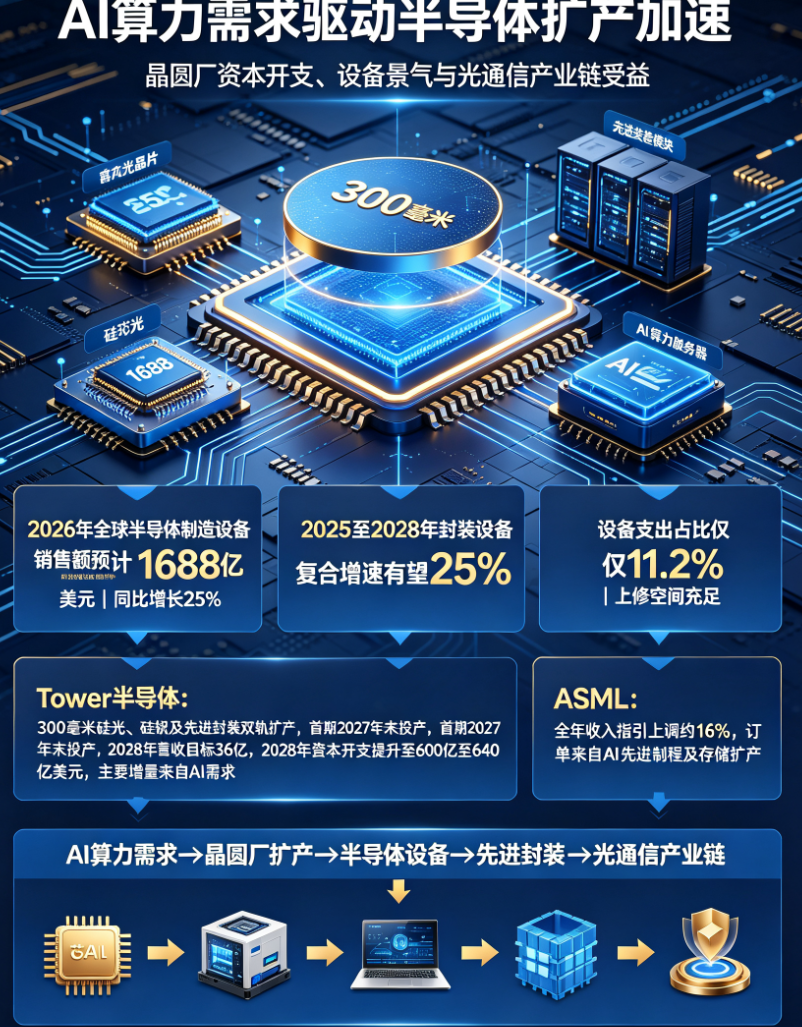
As artificial intelligence moves from the proof-of-concept stage to large-scale commercial deployment, the supply-demand imbalance in underlying hardware infrastructure is intensifying at an unprecedented pace. In the second half of 2026, the global semiconductor industry chain released multiple key signals: Tower Semiconductor launched a dual-track expansion for 300mm silicon photonics, silicon germanium, and advanced packaging, with the initial phase expected to start production by the end of 2027, while significantly raising its 2028 revenue and net profit targets to $3.6 billion and $1.2 billion; TSMC exceeded expectations in Q2 results while raising its full-year capital expenditure to $60-64 billion, with the main increment coming from AI demand; ASML also raised its full-year revenue guidance by about 16% on better-than-expected results, with orders mainly from AI advanced processes and memory expansion. These moves are not isolated events but a microcosm of the collective acceleration of global fab expansions against the backdrop of rapidly materializing AI computing power demand.
This expansion wave not only directly drives upstream semiconductor equipment orders but also brings advanced packaging, silicon photonics technology, and optical communication components—originally hidden deep in the industry chain—into the market spotlight. This article will delve into the underlying drivers and long-term impact of this AI-driven semiconductor expansion cycle from three perspectives: capital expenditure trends, equipment demand structure, and industry chain beneficiary logic.
I. Accelerated Fab Expansion: A New AI-Driven CapEx Cycle
1.1 From "Computing Anxiety" to "Capacity Anxiety"
Over the past two years, the exponential growth in AI model parameter counts has triggered a frenzy of global investment in computing infrastructure. However, the supply bottleneck for the physical carrier of computing power—chips—is shifting from the design side to the manufacturing side. TSMC raised its CapEx ceiling to $64 billion, and ASML's orders are mainly from AI advanced processes, indicating that leading fabs have realized that traditional capacity expansion rhythms cannot meet the composite demand of AI chips for advanced processes, advanced packaging, and special materials (such as silicon photonics and silicon germanium). Tower Semiconductor's dual-track expansion strategy is a typical manifestation of this judgment—simultaneously betting on silicon photonics integration and silicon germanium heterogeneous integration, aiming to seize the lead in AI computing power transmission and sensing.
1.2 Equipment Spending Ratio at Historical Low: Ample Room for Upward Revision
A view from an industry research report deserves high attention: currently, global semiconductor equipment spending as a share of semiconductor sales is only 11.2%, at a historical low. Looking back at the history of the semiconductor industry, as technology nodes enter below 3nm and advanced packaging becomes a key lever for performance improvement, the intensity of equipment investment must rise significantly. Take TSMC as an example: its 2026 CapEx as a percentage of revenue has exceeded 35%, far above the industry average, driven by the massive demand from AI chips for cutting-edge equipment such as EUV lithography, hybrid bonding, and through-silicon vias. The report forecasts that global semiconductor manufacturing equipment sales will reach $168.8 billion in 2026, an increase of 25% year-on-year, with potential for continued upward revisions over the next three years.
1.3 Memory and Logic Expand Simultaneously, Equipment Demand Diversifies
In past semiconductor cycles, memory and logic expansions often alternated. But this cycle is different—AI requires both high-bandwidth memory for data throughput and advanced logic processes for computational efficiency. ASML's orders simultaneously point to AI advanced processes and memory expansion, meaning DRAM and NAND Flash manufacturers are also heavily purchasing lithography machines to stack more layers. This "logic + memory" dual-wheel drive model will make the equipment industry's prosperity more resilient.
II. Advanced Packaging and Silicon Photonics: The Most Elastic Equipment Demand Sectors
2.1 Why Advanced Packaging Suddenly Became a "Rigid Need"
Traditional Moore's Law is slowing below 3nm, and chip performance improvement increasingly relies on packaging technology innovation. AI accelerators need to integrate heterogeneous chips such as compute chips, high-bandwidth memory, and silicon photonic transceivers into a single package, which has spurred explosive demand for advanced packaging processes like hybrid bonding, wafer-level packaging, and 3D stacking. Research reports indicate that from 2025 to 2028, the compound growth rate of packaging equipment is expected to reach 25%, far above the average growth of the overall equipment industry. Among them, mid-to-back-end equipment such as bonders, grinders, and testers have the greatest elasticity, as these steps directly determine the yield and performance of multi-chip integration.
2.2 Silicon Photonics: A Tipping Point from Lab to Volume Production
Tower Semiconductor's launch of a 300mm silicon photonics line marks the official transition of silicon photonics technology from R&D pilot to volume production. Silicon photonics technology uses existing CMOS processes to fabricate optical components, significantly reducing optical module costs and improving integration, making it a key solution to the data transmission bottleneck in AI computing systems. Especially with the adoption of 800G and 1.6T optical modules, the demand for silicon photonics chips will grow exponentially. Meanwhile, silicon germanium technology achieves lower power consumption while maintaining high-speed performance, and their combination forms a highly promising technology platform.
2.3 Equipment Order Visibility Significantly Extended
In the past, the order visibility for semiconductor equipment was typically 6 to 12 months. But as fabs initiate medium-to-long-term expansions, the on-hand order cycle for equipment suppliers has extended to 2 to 3 years. Tower Semiconductor's significant upward revision of its 2028 performance targets is based on the certainty of its equipment procurement and production ramp-up. Similarly, leading equipment suppliers such as ASML, Applied Materials, and Tokyo Electron have all raised their revenue guidance for the coming years, and the market is redefining the equipment industry from "cyclical" to "structural growth."
III. Industry Chain Beneficiary Landscape: Comprehensive Catalysis from Equipment to Optical Devices
3.1 Semiconductor Equipment Suppliers: Full Order Books, Valuation Recovery Imminent
AI computing power demand directly drives logic and memory expansion, and front-end equipment such as lithography machines, deposition equipment, etch equipment, and ion implanters will continue to benefit. Take ASML as an example: its EUV lithography machines have become a must-have tool for nodes below 3nm, and the introduction of High-NA EUV lithography further raises the unit value. For mid-to-back-end equipment, demand for bonders, grinders, and temporary bonding/debonding equipment is even stronger. These equipment suppliers will enter a peak performance realization period in 2027-2028.
3.2 Optical Communication and Optical Devices: Biggest Beneficiaries of the Silicon Photonics Wave
The industrialization of silicon photonics technology relies on supporting optical devices such as lasers, modulators, and detectors. After Tower Semiconductor starts production of its silicon photonics line, it will directly drive demand for upstream laser chips, optical amplifiers, optical fiber connectors, and other products. Leading domestic and international optical device companies have already begun coordinating capacity with fabs, and it is expected that the optical communication industry chain will see a wave of orders "driven by fabs" after 2027. This differs from the past model driven by data center construction, as fab expansions offer higher certainty and longer lifecycles.
3.3 Testing and Metrology Equipment: Key Moat for Yield Control
The complexity of advanced packaging has greatly increased, placing higher demands on defect inspection and electrical measurement. In 2.5D/3D packaging, microscopic defects at microbumps, through-silicon vias, and hybrid bonding interfaces can cause entire chip failures, so demand for inline inspection equipment (such as electron microscopes, X-ray inspection) and process control equipment will surge simultaneously. This segment of the equipment market has long been dominated by a few suppliers, with strong barriers and pricing power.
IV. Conclusion: Seize the "Golden Five Years" of AI Hardware Infrastructure
From Tower Semiconductor's expansion plans to TSMC's and ASML's performance guidance, all signals point to one conclusion: AI computing power demand is spreading from cloud data centers to edge devices, and from training to inference, driving the semiconductor industry into a structural expansion cycle centered on "advanced packaging + silicon photonics + specialty processes." The fact that the equipment spending ratio is at a historical low provides ample safety margin for future upward revisions.
For investors, the current juncture warrants attention on three main lines: first, leading players with advanced packaging equipment exposure, especially mid-to-back-end equipment suppliers for bonding, thinning, and testing; second, silicon photonics and optical communication component suppliers—as Tower and other fabs ramp up, their earnings elasticity will be significantly released; third, fabs with AI chip manufacturing foundry capabilities—their CapEx plans will continue to catalyze equipment orders.
From 2026 to 2030, global semiconductor equipment sales are expected to reach over $200 billion. In this process, companies that master core technologies and are deeply embedded in the AI industry chain will be able to transcend cycles. The construction of AI hardware infrastructure is just beginning, and the semiconductor equipment and optical communication chain is the most promising seat at this feast.