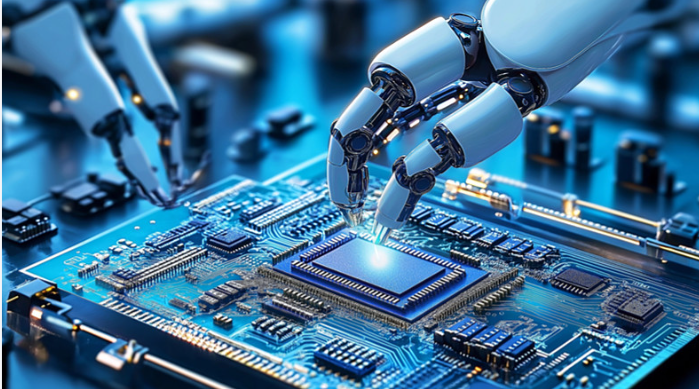
There is a critical industry: if it collapses, the internet, cloud, 5G, and everything will cease to exist. The nation's high-tech path would be interrupted overnight, affecting everyone's life. This is the semiconductor industry.
Its importance is self-evident. Under such circumstances, what investment opportunities exist?
I have worked in semiconductors my entire life—my bachelor's, master's, and doctoral degrees are all in semiconductor-related fields. I worked in the semiconductor sector in Silicon Valley, and later founded two semiconductor companies, both of which went public. I started investing ten years ago, and I still invest in the semiconductor industry.
"Bitter Memories of China's Chip Industry"
Why must we invest in semiconductors? Ten years ago, a "big shot" once said, "You can make money in every field, but there is only one field that is not profitable: the semiconductor industry." At that time, they had just invested in Spreadtrum Communications, a company I founded. He was telling the truth then; although the stock price later rose and they made money, it was indeed not profitable at that time.
Over the past decade, I have led various funds in investing in semiconductors. In 2010, I founded Huashan Capital. We invested in GigaDevice, and after five or six years, it went public, yielding a 30x return, now 70x. In 2014, I founded Puhua Capital, and later completed two international mergers and acquisitions, along with 18 domestic projects. So far, we have reaped three main board IPOs, one Hong Kong IPO, one US IPO, four STAR Market listings, and two STAR Market filings. Overall, we have achieved excellent returns. Additionally, the fund we established last year invested in a dozen projects, with an internal rate of return (IRR) of 60%.
Over these ten years, I have proven with my own experience that if the semiconductor industry is done right, returns can be harvested.
When I went abroad in 1989 and returned to China in 2000, the Chinese semiconductor industry was in shambles. Almost all of the hundreds of semiconductor companies I knew had gone bankrupt or been acquired. In other words, in 2000, the semiconductor industry started almost from scratch.
Around 2000 was the wild growth stage of the semiconductor industry. Thousands of companies sprang up overnight. A decade later, the vast majority had fallen; those that survived were highly resilient and gave birth to several leaders, developing very rapidly.
A set of data shows that in 2000, the annual sales of the entire integrated circuit industry were less than $100 million. By 2018, it reached $37 billion, and this year it is about $45 billion, a more than 400-fold increase in 20 years. But this is far from meeting market demand. Our import volume has risen from $100 billion to over $300 billion today.
In 2014, the semiconductor industry received policy favor. At that time, there was considerable controversy over how to develop and whether to follow the model of large state-owned enterprises. Ultimately, consensus was reached through the establishment of market-oriented funds, and the National Integrated Circuit Mega-Fund was created.
Over the years, there have been many debates about the achievements and problems of semiconductor development, but there is no debate on one point: if the national mega-fund had not been established five years ago, the entire industry would be in even greater difficulty today. The mega-fund does what market funds cannot. The most important two aspects are, first, foundry capacity—expansion of semiconductor processing capabilities; second, development of semiconductor memory.
Due to long return cycles and large capital requirements, the semiconductor industry indeed needs state support. Over the past five years, thanks to market and government support, it has developed rapidly. Additionally, government intervention has increased opportunities for mergers and acquisitions both domestically and internationally.
The Era of Land Grabbing: No Time to "Raise Horses"
The semiconductor field is very narrow; it is the "road builder" of the information highway. Starting last year, friends often asked me, "What is a chip?" and "You've been working on chips for decades—why is our chip industry still so weak?" I explain: almost everything is bottlenecked by semiconductors.
Developing chips is definitely a protracted war. This market was originally closed. Suddenly, a huge market opened up before all companies, including wireless base stations, industrial white goods, automotive, industry applications, etc. The large corporations in these industries, including Huawei, previously did not use Chinese chips. Now almost all companies recognize the crisis.
Overnight, all companies are looking for domestic alternatives. We have invested in many chip design companies, and they are incredibly busy now. This is the era of land grabbing in the chip market. There is absolutely no time to "raise horses"; companies with some accumulations should rush in immediately. We believe that within about two to three years, Chinese leaders will emerge in all sub-segments.
One question: how big is the gap between China's semiconductor industry and the world level? I believe we have caught up in packaging, design can catch up in about five years, manufacturing is more difficult—about 10 to 15 years. The hardest are equipment and materials, which require time—about 10 to 20 years. Right now, these areas are in a state of total mobilization and hard work.
The Semiconductor Industry Will Usher in a Golden Decade
Investment opportunities in the semiconductor industry are far better than in the past decade. Previously, investing in a semiconductor company meant waiting about ten years for an IPO; the next wave will not take that long.
Ten years ago, the semiconductor industry was primarily driven by returnees starting businesses. Now, over 80% are domestic startups. A few years ago, returnees were taking detours; now they are starting their second ventures—with customers, resources, and support from leading companies.
Ten years ago, it was purely "domestic substitution." Now, many micro-innovations arise from market demands. The cycle for successful startups has shortened, and the IPO environment has improved. Before 2016, almost no semiconductor companies went public; this year, there are over ten. The STAR Market is almost a green channel for hard tech or semiconductors. In this context, mergers and acquisitions will become more common.
But problems exist. Semiconductors have become a star industry, leading to many "PPT companies" whose valuations skyrocket before products exist. These have no investment value.
People like to say "pigs on the wind." We are 100% opposed to this notion. "Wind" generally lasts two to three years, not longer. 3D printing, VR, and P2P have all had their winds, but almost no venture capital made money. Therefore, in the hard tech field, we must not chase trends; instead, we should look at tides—the tide of industrial shifts.
The semiconductor industry will usher in a golden decade, bringing super returns. When investing in this field, pay attention to the following points.
First, act according to market rules. The government does its part; the market does its part. Never interfere. Second, be mentally prepared for long-term hardship. Third, the team must be highly professional, understand the industry, conduct in-depth research, and accumulate industrial resources and experience. Fourth, distinguish between financial investment and industrial investment. Fifth, the semiconductor industry is an ecosystem of collaboration; few VCs "go it alone." Newcomers should first cooperate with experienced institutions to avoid jumping into traps on impulse.