South Korea's Semiconductor Sector Plummets: Faith in AI Memory 'Super Cycle' Tested
Introduction: From Unilateral Surge to Sudden Collapse
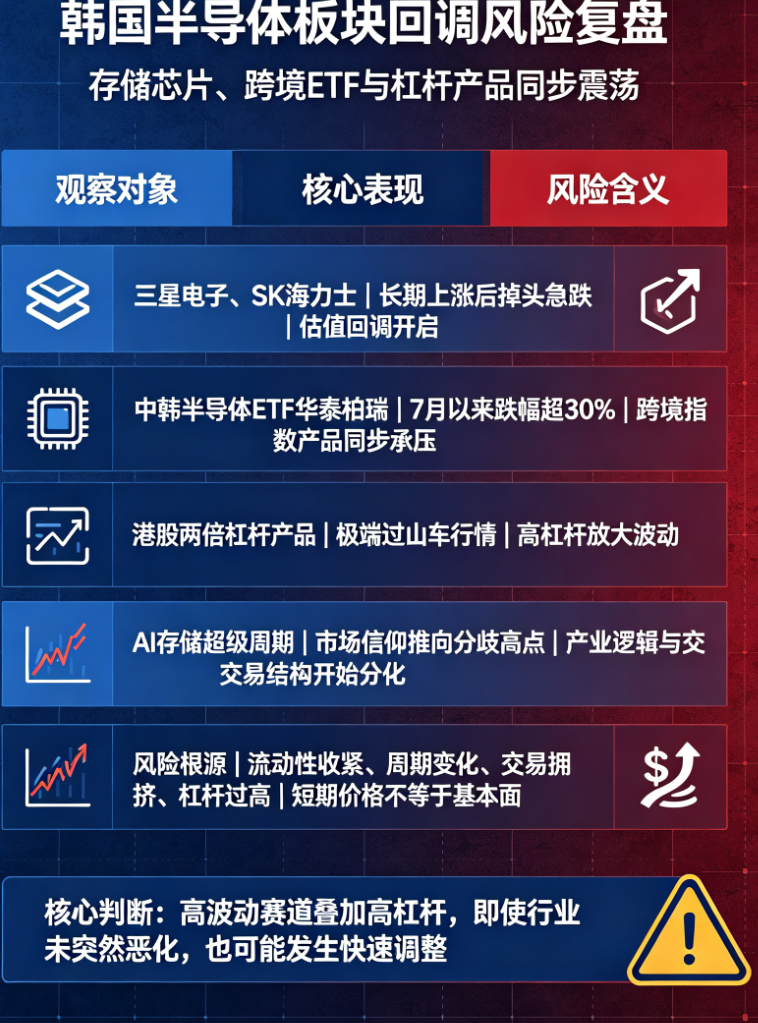
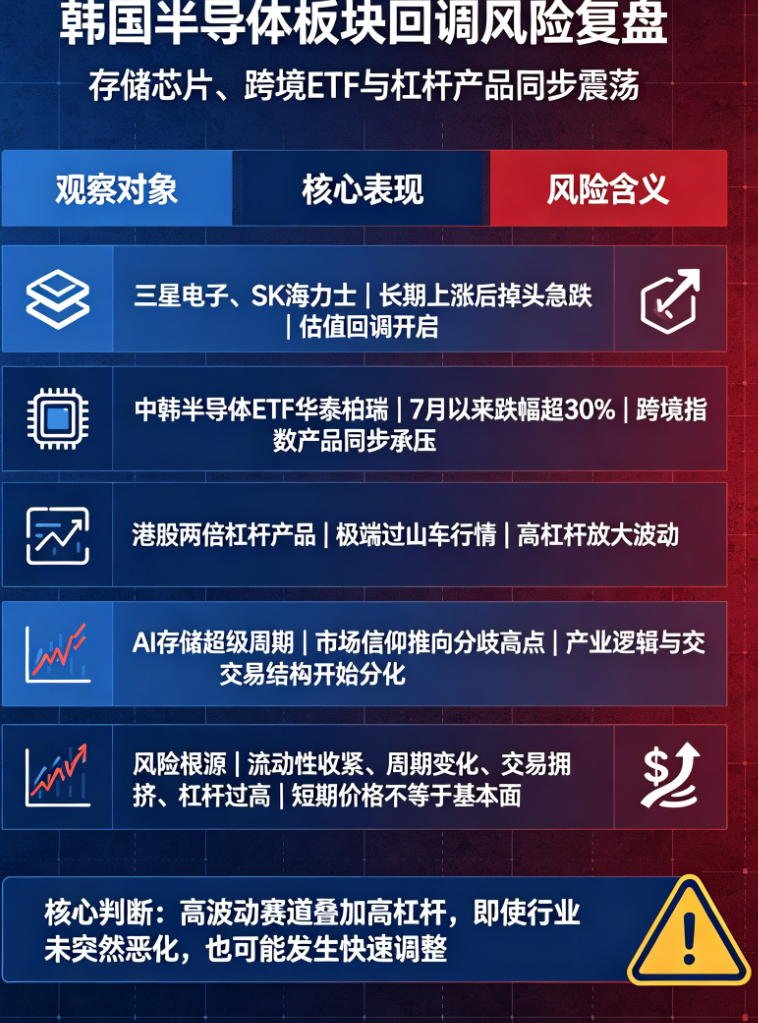
Over the past six months, South Korea's semiconductor sector was a shining star in global capital markets, with Samsung Electronics and SK Hynix seeing their stock prices double amid expectations of an explosion in AI memory demand. However, this strong momentum has come to an abrupt halt recently—the two leading stocks have reversed sharply downwards, marking the official end of a six-month unilateral rally. The China-South Korea Semiconductor ETF (Huatai-PineBridge), the only cross-border ETF focused on the Korean market, has also taken a heavy hit, falling over 30% since July. Two-times leveraged products linked to Korean stocks in the Hong Kong market have experienced extreme 'roller-coaster' movements, with market sentiment sharply diverging, pushing faith in the AI memory 'super cycle' to a peak of disagreement.
Catalysts for Valuation Correction: Multiple Pressures Converge
The sharp decline in South Korea's semiconductor sector is by no means due to a single factor. Global capital market liquidity continues to tighten, Fed interest rate policy expectations are volatile, and there are clear signs of capital exiting high-risk assets. At the same time, the industry cycle is showing marginal changes: although demand for high-bandwidth memory (HBM) from AI servers remains strong, the pressure from oversupply of traditional memory chips (DRAM, NAND) has not eased, leading to doubts about the sustainability of the memory semiconductor 'super cycle'. More critically, the previous continuous stock price rise accumulated a large amount of profit-taking positions, resulting in an extremely unbalanced trading structure—overly concentrated holdings, overcrowded capital, and high leverage ratios. At the slightest sign of trouble, the market can undergo rapid adjustments rather than waiting for fundamentals to deteriorate.
The Double-Edged Sword of Leveraged Products: A Risk Education Lesson
The plunge of the two-times leveraged products in the Hong Kong market is the most extreme case in this round of adjustment. These products were designed to amplify returns, but when the underlying asset drops sharply by 20%, their net asset value can be wiped out by over 60%, triggering forced liquidation mechanisms and creating a chain reaction of 'longs killing longs'. China Asset Management pointed out that the circuit breaker mechanism in the Korean market serves as a heavy warning: high-volatility tracks combined with excessive leverage are often the root of risk. Short-term market prices sometimes do not fully equate to changes in industry fundamentals; when capital structure is imbalanced, the market's self-correction often occurs through violent shocks.
Diverging Outlooks: Can the Super Cycle Faith Endure?
Currently, market views on the future of South Korea's semiconductor sector are sharply divided. Optimists believe that AI memory demand is just entering a period of explosion, and technological iterations like HBM 3E and even HBM 4 will continue to boost the profitability of Samsung and SK Hynix; the current decline is merely a technical correction after overvaluation, with no deterioration in fundamentals. Pessimists point out that global demand for end-consumer electronics has been weak for a long time, and the boost from AI servers to memory chips has already been fully priced into stocks; once AI investment growth slows, memory semiconductors will face more severe supply-demand imbalances. Additionally, geopolitical risks and the uncertainty of US-China tech decoupling cast a shadow over South Korean semiconductor exports.
Conclusion: Rebalancing Bubbles and Fundamentals
The massive turbulence in South Korea's semiconductor sector is essentially the market's process of returning from extreme optimism to rationality. In the short term, valuation compression may not yet be over, as global liquidity tightening and marginal changes in the industry cycle will continue to dominate the market. However, in the long term, the certainty of AI memory demand cannot be denied, and Samsung and SK Hynix's competitive advantages in the HBM field remain solid. What investors need most at this point is to remain calm: rationally distinguish short-term market sentiment fluctuations from long-term industry trends, avoid mistakenly selling core assets in a panic, and be even more vigilant about the destructive risk of leverage tools in volatile markets. After this round of adjustment, the valuation of memory semiconductors will be closer to fundamentals, and the market will re-examine the true boundaries of the 'super cycle'.