New Capital Channel: How the 18C Special Technology System Reshapes the Wide Bandgap Semiconductor Industry Landscape
With the deep transformation of the global technology industry, silicon carbide, as the core representative of third-generation semiconductor materials, is leading the technological revolution in the era of new energy and high computing power with its excellent physical properties. From electric drive systems in electric vehicles to power management in AI computing centers, from inverters for wind-solar-storage-charging to power modules for high-speed rail traction, silicon carbide power devices have become an indispensable cornerstone supporting the modern electronic information industry. However, behind this prosperous scene, companies in the industry generally face practical difficulties such as high R&D investment, long return cycles, and high profitability thresholds. Recently, Basic Semiconductor successfully listed on the main board of the Hong Kong Stock Exchange using Chapter 18C of the HKEX Listing Rules, becoming the first listed silicon carbide IDM company. This milestone event not only opens a new capital channel for the company itself but also provides a benchmark reference for the financing model of the entire wide bandgap semiconductor industry.
Introduction: The Capital Time Lag of the Wide Bandgap Industry and the Path to Breakthrough
Currently, AI computing power infrastructure and the new energy vehicle industry are expanding at an unprecedented pace. Data shows that by the end of 2025, the global silicon carbide power device market size has exceeded $5 billion, with China accounting for more than one-third of the share. However, unlike the mature commercialization path of silicon-based semiconductors, the silicon carbide industry is characterized by high R&D investment and long return cycles. A complete silicon carbide industry chain, from wafer growth and chip design to module packaging, requires multiple rounds of technology iteration and capacity ramp-up, making it extremely difficult to achieve large-scale profitability in the short term. This "time lag" in value release puts silicon carbide companies at a long-term disadvantage in the evaluation system of traditional capital markets, making it hard to obtain financial support commensurate with their technological prospects.
Against this backdrop, the introduction of the HKEX Chapter 18C Special Technology System is like a timely rain. This system allows unprofitable but high-growth potential technology companies to use indicators such as market capitalization and R&D investment instead of profitability as the core listing review criteria. Basic Semiconductor's listing practice is a typical example of this institutional innovation, demonstrating the possibility of a two-way interaction between the capital market and hard tech industries.
The 18C Framework: Unblocking Capital Bottlenecks for Long-Cycle Technology Companies
The Internal Logic of System Design: From "Profit-Oriented" to "Technology Value"
The wide bandgap semiconductor IDM (Integrated Device Manufacturing) model requires companies to simultaneously possess full-chain capabilities in chip design, wafer manufacturing, module packaging, and driver solutions. This asset-heavy, long-cycle business model often fails to pass reviews under traditional listing rules due to poor profitability data. Dr. Weiwei He, President of Basic Semiconductor, pointed out in an exclusive interview with China Electronics News: "Silicon carbide IDM is a track with heavy assets, long cycles, and high R&D investment, requiring continuous capital injection before large-scale profitability. The 18C channel allows technology prospects and industry growth potential to be the core listing focus rather than demanding short-term profitability indicators, which highly aligns with the development laws of the silicon carbide industry."
The system design of the Chapter 18C Special Technology System benchmarks the most advanced capital market communication mechanisms globally. It no longer takes short-term profitability as the core evaluation standard, but focuses on assessing a company's technology moat, R&D intensity, and market growth potential. For Basic Semiconductor, since its establishment in 2015, the company has cumulatively invested over RMB 5 billion in R&D, building a complete product matrix covering automotive-grade silicon carbide MOSFETs, SBDs, modules, and driver ICs, with more than 300 core patents. Under the 18C framework, such technological accumulation can be fully recognized and priced by the capital market.
The Strategic Value of an International Platform: Dual Empowerment of Capital and Market
Unlike the STAR Market or ChiNext, the Hong Kong stock market, as an international capital platform, can not only connect global industrial capital to continuously provide stable funds for capacity expansion and R&D but also help companies expand overseas customers and cooperation channels. Dr. Weiwei He emphasized: "As the first silicon carbide IDM special technology company listed in Hong Kong, the listing will significantly enhance the company's brand recognition in the global power semiconductor industry, opening new opportunities for expanding overseas customers and partners."
From an industry ecosystem perspective, this step has greater strategic significance. Currently, although the domestic silicon carbide supply chain is growing rapidly, there is still a significant local supply gap. According to industry research data, in 2025, China's self-sufficiency rate in silicon carbide devices is still less than 30%, especially in high-end automotive-grade and AI server fields, where dependence on imports is high. The Special Technology System exactly fills this gap in the capital mechanism, allowing companies with core technologies but still in the value accumulation phase to gain early trust and support from the capital market. Basic Semiconductor's successful listing provides a path reference for similar companies in the future, potentially attracting more long-term capital to the domestic wide bandgap semiconductor industry, forming a positive cycle of "technology breakthrough - capital support - capacity expansion - market application."
Dual-Line IDM Layout: Synergistic Development of AI Computing Power and New Energy Vehicles
Technology Resonance: Common Demands of Two Major Tracks for Silicon Carbide Devices
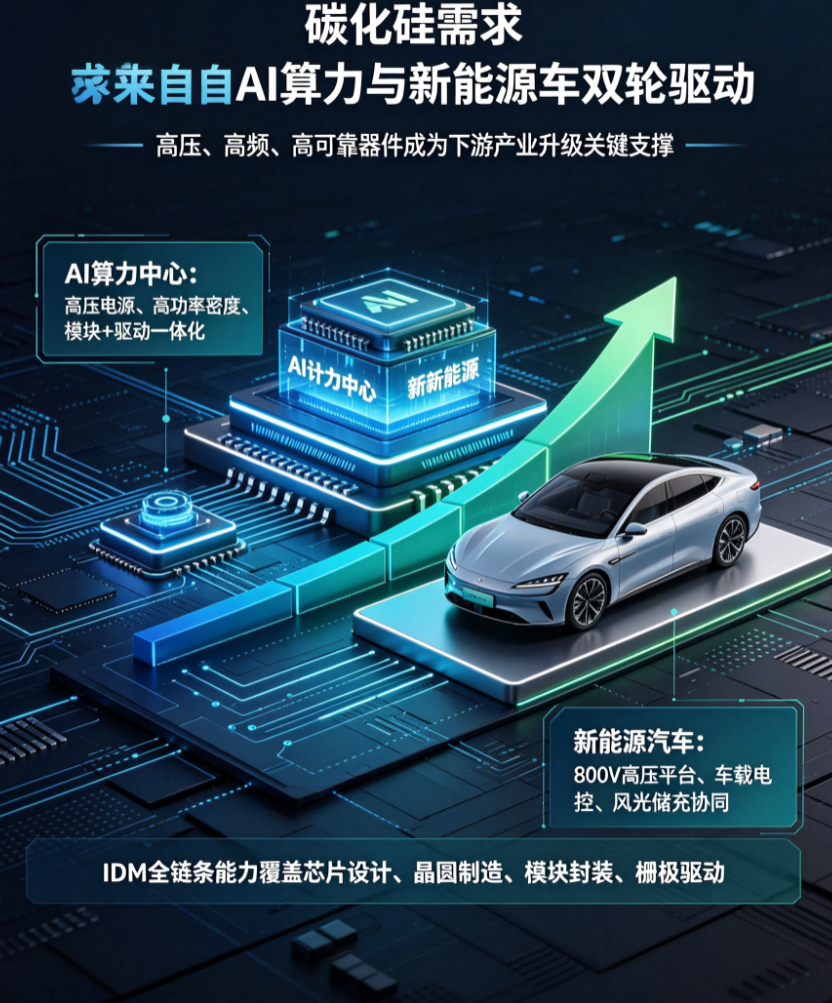
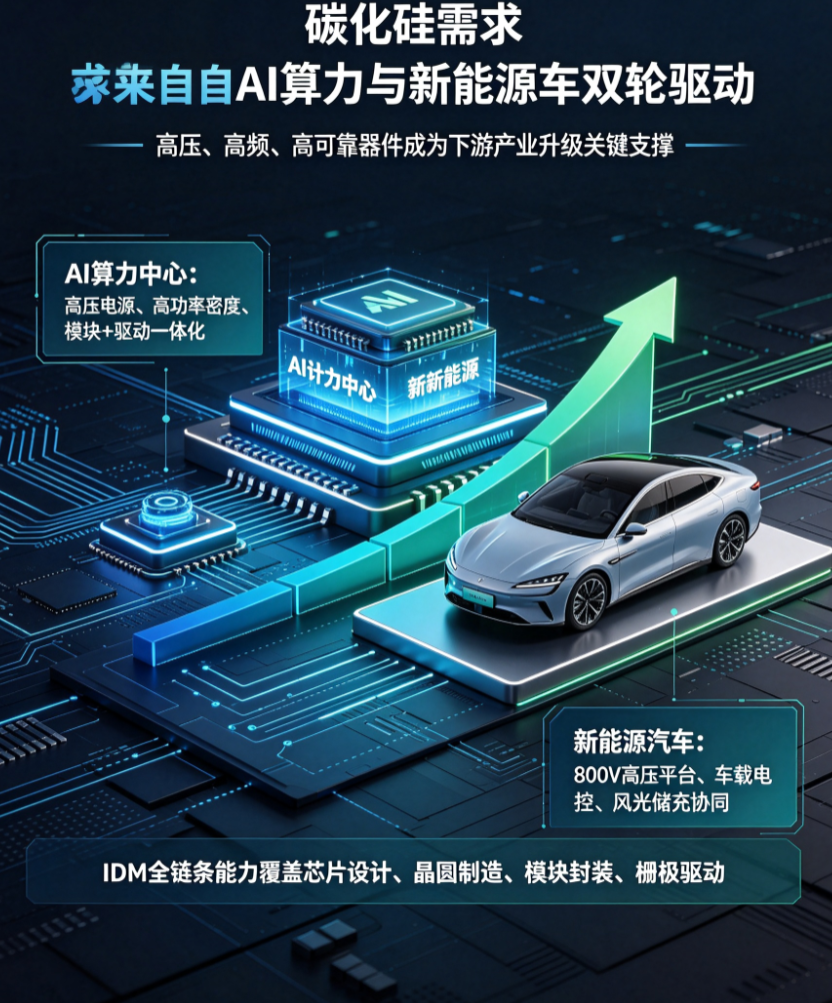
Basic Semiconductor's current listing proceeds will be primarily used for production line expansion and new product R&D, continuing to expand into two core tracks: AI computing centers and new energy vehicles. Outsiders are curious how these two seemingly different markets can achieve synergy in technology and resources. Dr. Weiwei He gave a clear answer: "AI computing centers and automotive applications have considerable overlap in requirements for silicon carbide devices; both need high voltage, high frequency, and high reliability performance support."
The 800V high-voltage platform for new energy vehicles requires power devices to withstand operating voltages up to 1200V while maintaining extremely low switching losses under high-frequency switching. The power system of AI computing centers also needs to provide stable power output under high-voltage, high-frequency conditions to meet the peak computing demands of GPU clusters and server units. Silicon carbide MOSFETs, with their wide bandgap material characteristics of high breakdown field strength, high electron saturation velocity, and high thermal conductivity, naturally fit the stringent requirements of these two application scenarios. As a domestic IDM company covering the full chain of silicon carbide chip design, wafer manufacturing, module packaging, and gate driver, Basic Semiconductor's full-stack capabilities can simultaneously support both tracks, enabling two-way empowerment of technology and market.
Capacity Strategy: Three-Region Collaborative Dynamic Allocation Capability
In terms of capacity layout, Basic Semiconductor has demonstrated forward-looking planning. The company has deployed a wafer manufacturing base in Shenzhen, and module packaging bases in Wuxi and Zhongshan, leveraging the production lines in these three locations for dynamic capacity allocation, simultaneously targeting the new energy vehicle and AI computing center markets. By the end of 2025, the company has secured design wins from over 20 automakers for more than 80 vehicle models, covering the full spectrum from A00-level mini cars to luxury flagship sedans. Meanwhile, in the AI computing center field, its products have achieved mass production and delivery, serving multiple leading cloud service providers and computing infrastructure companies. The two growth curves support each other, effectively diversifying industry cycle risks, forming business resilience where "if one direction is dark, the other is bright."
Dr. Weiwei He further introduced that the raised funds will accelerate capacity ramping of existing production lines, complete process upgrades, and prepare capacity reserves for market growth in AI computing centers, new energy vehicles, wind-solar-storage-charging, etc. In the future, the company will continue to iterate silicon carbide MOSFET chip technology, develop more high-power-density devices suitable for AI scenarios, and build integrated "module + driver" solutions. As demand for 800V high-voltage vehicles and high-voltage AI computing center power supplies continues to rise, this solution can meet customers' full machine development needs in one stop, significantly reducing customer development cycles and forming a unique competitive advantage. For example, in power modules for AI data centers, adopting Basic Semiconductor's "module + driver" solution can increase system efficiency to over 98.5% while shortening design cycles by 30%-40%, creating significant time and cost value for customers.
Conclusion: Capital Support is an Accelerator, but Independent Innovation is Fundamental
The implementation of the HKEX Chapter 18C Special Technology System has undoubtedly injected strong momentum into the wide bandgap semiconductor industry. Basic Semiconductor's listing practice not only validates the suitability of this system for long-cycle hard technology companies but also provides a clear blueprint for the industrialization path. However, capital market support is an accelerator for industrial development, not the end point.
In the future, domestic silicon carbide companies still need to continuously deepen process innovation, capacity construction, and product deployment. The competition in the silicon carbide industry is essentially a marathon of technology, capital, and time. From defect density control during wafer growth, to gate oxide reliability in chip design, to thermal management in module packaging, every link requires deep technological accumulation and a craftsman's spirit of continuous improvement. Building full-chain technical capabilities is not only the foundation for companies to cope with market fluctuations but also the key to ensuring the supply chain security of downstream industries.
Basic Semiconductor, by integrating full-chain capabilities with the IDM model, hedging industry cycles with dual-line layout, and connecting to global markets through international capital, has explored a feasible path for the high-quality development of domestic silicon carbide companies. As the intelligent wave of new energy vehicles converges with the explosive growth of AI computing power, silicon carbide devices will move from behind the scenes to the forefront, becoming the core foundation supporting the digital economy and green transformation. For the entire power semiconductor industry, the transformation driven by the 18C system and the IDM model has just begun. In the future, as more similar companies enter the capital market, China's silicon carbide industry is expected to achieve a historic leap from "following" to "leading" in global competition.