FuChuang Precision's Half-Year Net Profit Surges Over 8x: Domestic Substitution in Semiconductor Equipment Accelerates, Core Component Leader Ushers in Explosive Period
Introduction
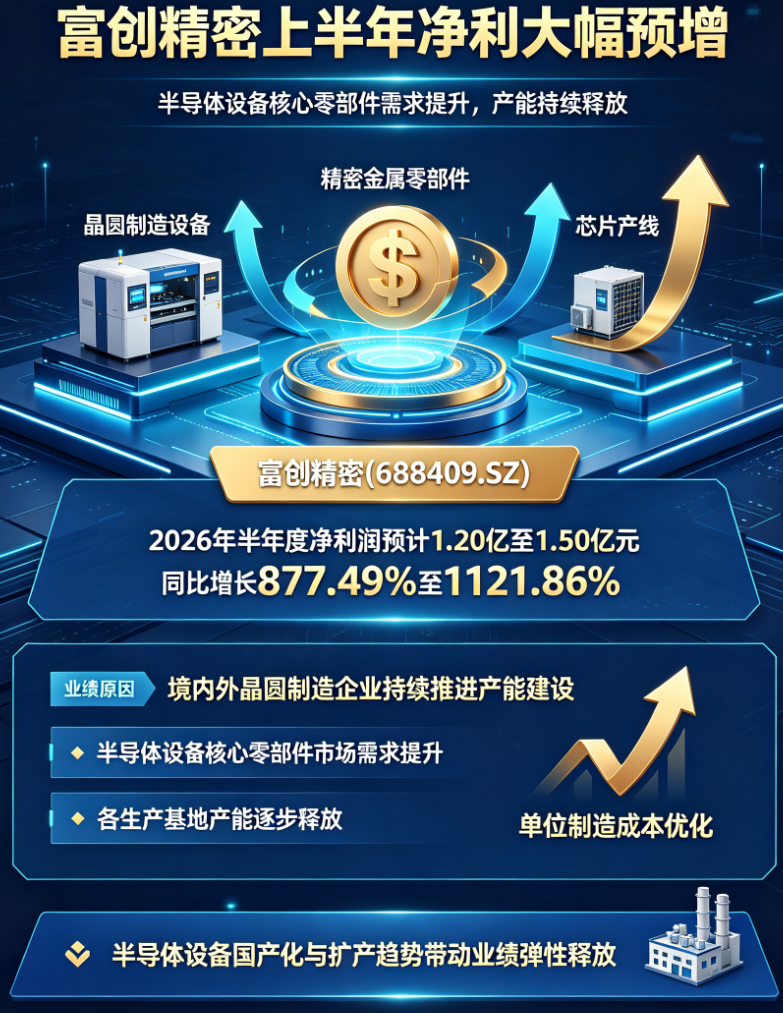
On July 19, 2026, FuChuang Precision (688409.SH) shocked the capital market with an announcement: the company expects its net profit attributable to shareholders of the listed company for the first half of 2026 to range from RMB 120 million to RMB 150 million, a year-on-year increase of 877.49% to 1121.86%. This astonishing growth rate not only set a new record for the company but also injected a strong boost into the development of core components for domestic equipment amid the cyclical fluctuations of the semiconductor industry.
In the semiconductor industry chain, core components are often one of the most "bottleneck" links. With deep expertise in precision machining and surface treatment, FuChuang Precision has become one of the few domestic suppliers capable of mass-producing key components for semiconductor equipment. This explosive growth is both a direct beneficiary of the global wafer fab expansion wave and a microcosm of China's accelerated semiconductor autonomy process. This article will deeply analyze the driving factors behind FuChuang Precision's stellar performance, explore the development trends of the core components industry for semiconductor equipment, and provide a forward-looking judgment on the company's future growth path.

1. Performance Forecast Analysis: Growth Momentum Behind the Numbers
1.1 Dual Engines of Profit Explosion
According to the announcement, FuChuang Precision's net profit for H1 2026 is expected to be between RMB 120 million and RMB 150 million, nearly ten times the base of approximately RMB 12.3 million in the same period last year. The main reasons for the performance change clearly point to two aspects: continued expansion on the demand side and capacity release on the supply side.
On the demand side, domestic and international wafer manufacturers are in a new round of capacity construction cycles. International giants such as TSMC, Samsung, and Intel, as well as domestic leaders like SMIC, CXMT, and YMTC, have announced tens of billions of dollars in capital expenditure plans over the past two years. The construction and mass production of these fabs directly drive procurement demand for core equipment such as etching equipment, thin film deposition equipment, and cleaning equipment. As indispensable components of these tools, precision parts including chambers, valves, piping, and seals naturally see rising market demand.
On the supply side, FuChuang Precision's production bases in Shenyang, Shanghai, Beijing, and other locations have gradually come online in recent years, easing capacity bottlenecks. The company explicitly stated in the announcement that "capacity at various production bases is gradually being released, and unit manufacturing costs are optimized," indicating that economies of scale are beginning to take effect. As fixed costs are spread out, marginal profit margins naturally improve. In precision manufacturing, cost savings from higher yield rates and shorter manufacturing cycles often generate profit elasticity several times greater than revenue growth.
1.2 Industry Comparison: Highlighting Leading Position
To understand the quality of FuChuang Precision's performance, it is useful to compare it with peers. During the same period, most companies in the A-share semiconductor equipment components sector saw growth, but generally between 50% and 200%. FuChuang Precision's nearly 9x increase far exceeds the industry average. Behind this are the company's comprehensive advantages in technical barriers, customer certification, and product category coverage—being able to serve international equipment giants such as Applied Materials, Lam Research, and Tokyo Electron while meeting the customized needs of domestic mainstream fabs. Such a dual customer structure provides a solid order base.
2. Demand Side: Global Semiconductor Equipment Market Ushers in "Super Cycle"
2.1 "Arms Race" of Wafer Fab Expansion
Investment in semiconductor equipment typically leads chip production by about 1 to 2 years. From 2025 to 2026, the global semiconductor industry is in a rare "dual expansion" phase: on one hand, the development and mass production of advanced nodes (3nm/2nm) require a large number of new equipment; on the other hand, mature nodes (28nm and above) are also actively expanding capacity to meet explosive demand in areas such as automotive electronics, IoT, and industrial control. According to SEMI, the global semiconductor equipment market is expected to exceed USD 150 billion in 2026, with the Chinese mainland market accounting for over 30%.
Fab expansion directly drives equipment orders, and core components of equipment are the first to benefit. For example, an inductively coupled plasma (ICP) etcher requires hundreds of precision metal chamber components, with machining precision requirements reaching micron or even sub-micron levels, and extremely high surface cleanliness and corrosion resistance. FuChuang Precision's technical accumulation in these areas makes it an irreplaceable partner for international equipment manufacturers in the global supply chain.
2.2 Domestic Substitution: From "Optional" to "Mandatory"
In recent years, as the US-China technology rivalry escalates, the localization security of semiconductor equipment supply chains has become a focus for all countries. For China, domestic substitution of core components has shifted from "icing on the cake" to "fuel in snowy weather." The components produced by FuChuang Precision were historically dominated by Japanese, Korean, and German companies, but as domestic technology breaks through, more equipment manufacturers are incorporating domestic suppliers into their first-tier supply chains.
Notably, FuChuang Precision's customer structure features "both domestic and foreign equally." Overseas key customers (e.g., Applied Materials, Lam Research) have high requirements and long certification cycles, which once passed, lead to long-term stable cooperation; domestic customers (e.g., NAURA Technology Group, AMEC) are growing rapidly, with demand for domestic components transitioning from "trial use" to "bulk procurement." This dual-wheel drive model effectively smooths cyclical fluctuations in a single market.
3. Supply Side: Capacity Release and Technical Barriers Build Moat
3.1 Capacity Construction and Cost Optimization
Since its listing, FuChuang Precision has continuously increased capital expenditure. According to the company's annual report, from 2024 to 2026, the new Shenyang plant, Shanghai Lingang base, and Beijing Yizhuang base were successively put into operation, with total capacity approximately three times that before listing. The direct benefit of large-scale production is a significant reduction in unit manufacturing costs—stronger bargaining power in raw material procurement, lower equipment depreciation cost per product, and improved production efficiency of skilled workers. Data shows that the company's gross margin for H1 2026 increased by about 8 percentage points compared to the same period in 2025, which is the fundamental reason for profit growth far exceeding revenue growth.
3.2 Technical Moat: "Hidden Champion" of Precision Machining and Surface Treatment
The core technology of semiconductor equipment components lies not only in mechanical machining precision but also in surface treatment processes. Under plasma environments, component surfaces require strong corrosion resistance, low outgassing rates, and uniform conductivity. FuChuang Precision possesses a variety of independently developed surface treatment technologies, including plasma spraying, anodizing, and electroless nickel plating, with some processes reaching advanced international levels. Additionally, the company's layout in materials science—such as the machining capabilities of special materials like ceramics, quartz, and silicon carbide—enables it to cover a full range of products from etching chambers to quartz windows, from silicon rings to vacuum valves.
3.3 "Time Barrier" of Customer Certification
The semiconductor equipment components industry has a very high barrier for customer certification. The component suppliers for an ASML lithography machine or an Applied Materials etcher need to undergo 1 to 3 years of process verification, reliability testing, and batch stability assessment. Once included in the supplier list, the switching cost for customers is extremely high because replacing components may affect overall equipment performance or even reduce machine yield. FuChuang Precision has accumulated over 100 international customer certifications, and this first-mover advantage is difficult for latecomers to replicate in the short term.
4. Future Outlook: Can High Growth Continue?
4.1 Growth Space Remains Broad
Although the performance base has significantly increased, FuChuang Precision's growth logic remains unchanged. On a macro level, the "super cycle" of the global semiconductor equipment market is expected to last until 2028. Specifically, with the explosive demand for AI chips, demand for equipment in areas such as HBM and advanced packaging is surging, and corresponding component orders are also growing rapidly. On a micro level, FuChuang Precision is still expanding its product categories, for example, moving into higher value-added areas such as gas delivery systems and vacuum systems, and actively laying out overseas production bases to circumvent trade barriers.
4.2 Potential Risks to Watch
Of course, behind high growth lie risks. First is the risk of industry cyclical fluctuations: the semiconductor industry has obvious cyclicality; once the global economy slows down or downstream demand saturates, equipment investment may drop sharply. Second is the risk of intensified competition: some domestic competitors are also actively expanding capacity, and the possibility of price wars cannot be ignored. Third is exchange rate risk: the company's overseas revenue accounts for about 40%; if the RMB appreciates significantly, it will negatively impact orders denominated in USD. Additionally, the uncertainty of the US-China technology rivalry may affect the stability of orders from overseas customers.
5. Conclusion
FuChuang Precision's nearly 9x year-on-year net profit growth in H1 2026 is the result of the resonance between the wave of domestic substitution in semiconductor equipment and the company's own capacity ramp-up. This data not only confirms the company's growth potential as a domestic core component leader but also reflects the acceleration of China's semiconductor industry chain autonomy. Against the backdrop of global wafer fab expansion, AI demand explosion, and supply chain security needs, FuChuang Precision is expected to continue enjoying industry growth dividends over the next 3 to 5 years.
For investors, the short-term surge in performance is certainly exciting, but more attention should be paid to the company's technical barriers, customer stickiness, and capacity expansion pace. Only by distinguishing "structural growth" from "cyclical growth" can one truly grasp the long-term value of the core semiconductor component track. For the entire Chinese semiconductor industry, the rise of FuChuang Precision is undoubtedly another important milestone as domestic substitution moves from "point breakthroughs" to "system upgrades."
(Data sources: company announcements, SEMI industry reports. Investment involves risks, caution is needed when entering the market.)