Global Semiconductor Market Turmoil: US Stock Divergence Amid South Korea Regulatory Storm and Geopolitical Risks
Keywords: US Stocks, Memory Chips, South Korea Regulation, TSMC, Middle East Situation, Gold and Silver Decline, Leveraged ETFs
Introduction
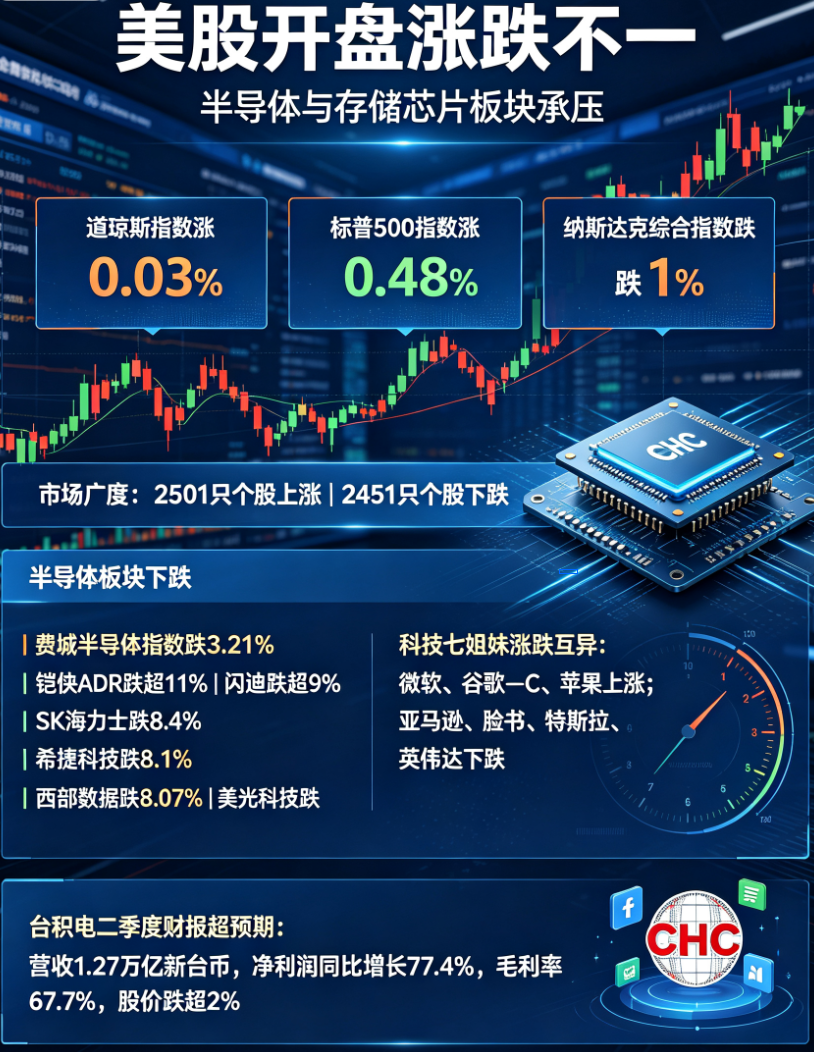
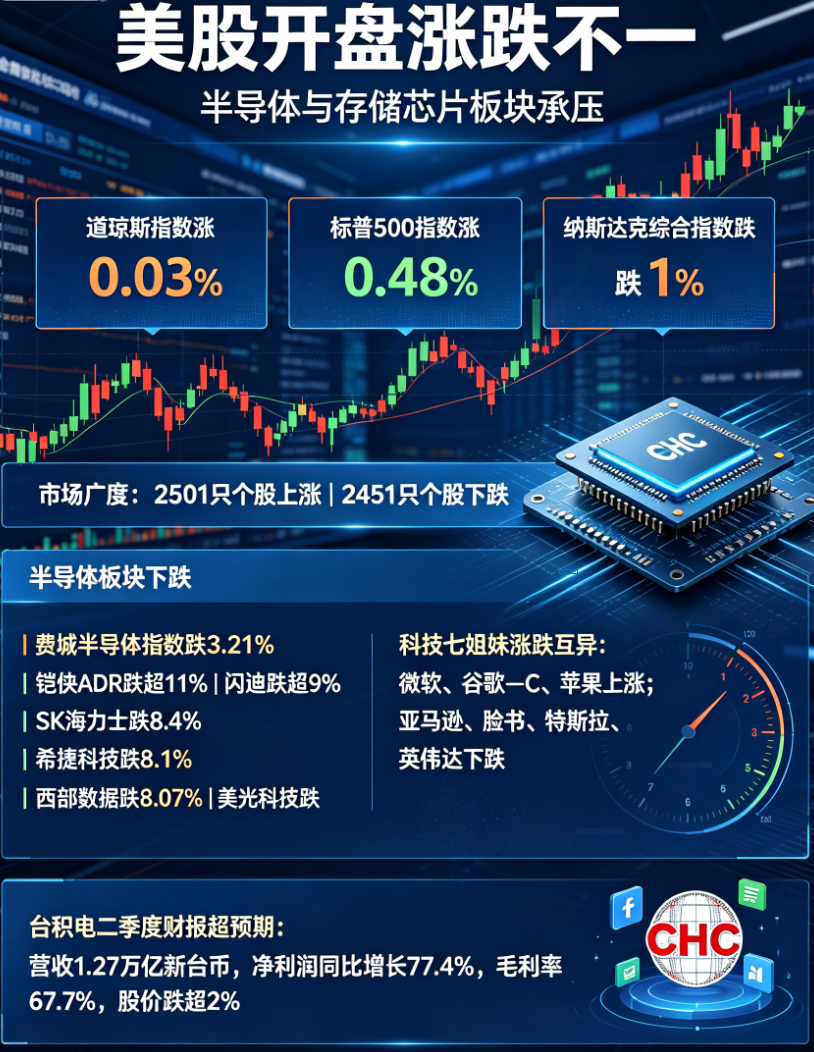
On July 16, 2026, US stock markets opened with divergence, with the Dow Jones Industrial Average edging up while the tech-heavy Nasdaq Composite faced heavy selling pressure. As of press time, the Dow was up 0.03%, the Nasdaq down 1%, and the S&P 500 barely up 0.48%. The surface seemed calm, but underlying currents were turbulent: 2,501 stocks rose, 2,451 fell, with bulls and bears in a stalemate. However, what truly ignited market sentiment was the collapse of the memory chip sector—Kioxia ADR plunged over 11%, SanDisk fell over 9%, SK Hynix dropped 8.4%, Seagate Technology fell 8.1%, and Western Digital fell 8.07%. Micron Technology fell over 5%, with its market cap slipping below $970 billion. The Philadelphia Semiconductor Index extended losses to 3.21%, with giants like ARM, Marvell Technology, Qualcomm, Intel, and AMD all suffering.
Meanwhile, the South Korean Financial Services Commission's new regulations on single-stock leveraged ETFs, announced on July 16, precisely targeted an active speculative fund source in memory stock trading. This policy, intertwined with escalating Middle East geopolitical tensions and market expectation adjustments following TSMC's earnings report, collectively shaped the complex landscape of capital markets that day. This article analyzes the causes, impacts, and future direction of this 'memory chip cold snap' from multiple dimensions.
1. Memory Chip Sector Rout: South Korea's New Regulations Trigger the Sell-off
1.1 Data Impact of Collective Declines
On July 16, Asian markets reacted first, with South Korea's two memory chip giants—SK Hynix plunging over 11% and Samsung Electronics falling over 8%. Subsequently, US markets opened, and related stocks continued their decline. The Philadelphia Semiconductor Index rapidly widened its loss to 3.21%, dragging tech leaders like NVIDIA and Tesla. This wave of decline was not an isolated event but a direct reaction to the tightening of leverage trading rules by South Korea's financial regulator.
1.2 Implications and Impact of South Korea's Regulatory Measures
The South Korean Financial Services Commission (FSC) officially announced a series of stringent measures against single-stock leveraged ETFs that day: the minimum margin was raised from KRW 10 million to KRW 30 million, with only cash accepted; each single-stock leveraged trade is limited to 20 shares; and new listings of single-stock leveraged products are prohibited. This policy was effectively a precise strike against the excessive speculation in the memory sector over the past few months.
Analysts noted that the memory chip sector had surged sharply year-to-date driven by AI computing demand expectations and stellar earnings from companies like Micron, becoming an amplifier of market sentiment and liquidity. South Korean regulators aimed to curb retail leveraged speculation and avoid systemic risk accumulation. However, such policy interventions often trigger short-term stampede effects—leveraged funds are forced to liquidate, accelerating stock price declines. The plunges in SK Hynix and Samsung Electronics are a direct manifestation of this mechanism.
1.3 Fundamentals vs. Sentiment
Although the new regulations suppressed stock prices in the short term, memory chip fundamentals have not deteriorated. KeyBanc analyst John Vinh maintained a positive outlook on the overall memory market, expecting NAND flash prices to rise 30% to 40% in Q3 and another 15% in Q4; HBM (High Bandwidth Memory) prices could double by 2027. Research analyst Shuli Ren recently reported that the global memory chip shortage will peak in Q2 2026, stabilize by Q1 2027, with potential oversupply by 2028. This suggests the current supply-demand imbalance is unlikely to reverse in the near term, and the price uptrend will continue.
Therefore, the current decline is more of a liquidity and sentiment adjustment rather than a fundamental reversal. The market needs to digest the liquidity shock from South Korea's new regulations and wait for new catalysts.
2. TSMC's Earnings Shine but Shares Under Pressure: The 'Sweet Burden' of High Expectations
2.1 Earnings Exceed Expectations
On July 17 (local time), TSMC released its Q2 2026 earnings report. Data showed TSMC achieved Q2 revenue of NT$1.27 trillion, up 36% year-over-year, above analysts' estimate of NT$1.264 trillion; net profit reached NT$706.6 billion, up 77.4% year-over-year, far exceeding the market estimate of NT$623.7 billion; gross margin was 67.7%, also better than expected. From any angle, this was an extremely impressive report card.
2.2 Why Did the Market React Negatively?
However, after the earnings release, TSMC's stock fell over 2%. This 'buy the rumor, sell the news' phenomenon highlights the importance of market expectation management. Ricky Ho, a fund manager at Singapore's Four Capital, succinctly noted: 'Market expectations for TSMC are already at an 'abnormally high level'; further stock price gains will increasingly depend on consistently beating market expectations.' When earnings, although strong, fail to significantly exceed already-high expectations, the stock faces downward pressure.
Additionally, the broad decline in the memory chip sector created a negative spillover effect. As a semiconductor industry leader, TSMC's stock was inevitably dragged down by sector sentiment. The expanding loss in the Philadelphia Semiconductor Index further suppressed market risk appetite.
2.3 Long-Term Thesis Unchanged
Despite short-term stock pressure, TSMC's monopoly position in advanced process and AI chip foundry remains unshaken. Its rising gross margin indicates strong pricing power and cost control. With the explosive demand for AI servers, autonomous driving, and HPC (High-Performance Computing), TSMC will continue to benefit from industry expansion in the coming years. Investors need to focus on distinguishing between 'good companies' and 'good prices' amid current high valuations.
3. Commodity Divergence: Oil Rises, Gold and Silver Fall
3.1 International Oil Prices Rise Collectively
In contrast to the tech downturn, international oil prices rose collectively on July 16. As of press time, WTI crude oil futures were up 1.08% at $80.46/barrel; Brent crude oil futures were up 1.08% at $85.87/barrel. Key drivers included escalating Middle East geopolitical tensions, rising expectations of OPEC+ production cuts, and declining global inventories.
3.2 Gold and Silver Prices Both Decline
Contrary to the oil rise, safe-haven assets gold and silver faced selling. Spot gold fell back below the $4,000 mark, down 1.67% at $3,991.79/ounce; spot silver fell 3.77% at $55.65/ounce. The decline in gold and silver may be related to a stronger US dollar index, hawkish signals from the Fed, and a temporary rebound in risk appetite. Notably, gold had previously hit an all-time high of $4,000 on safe-haven flows; the current pullback may be a technical correction.
4. Escalating Middle East Tensions: The 'Instability Factor' of the Strait of Hormuz
4.1 Iran's Strong Stance
On the geopolitical front, Middle East tensions escalated on July 16. Iran stated that day that the Strait of Hormuz would not reopen under US pressure. On the same day, the Iranian Armed Forces further warned: if Iran's infrastructure continues to be attacked by US forces, Iran will strike all infrastructure in the region. This means the world's most important oil transit chokepoint faces potential disruption. In the event of a conflict, oil prices could spike sharply.
4.2 Potential Risk of Expanded US Strikes
Earlier, the Wall Street Journal, citing US officials, reported that US President Donald Trump is considering expanding military strikes against Iran but has not made a final decision. This news heightened market concerns about a full-scale war. While geopolitical risks typically boost safe-haven assets, the current decline in gold and silver suggests the market is still assessing the scope and duration of the conflict, with short-term capital likely favoring the US dollar and crude oil.
5. Outlook and Conclusions: Investment Logic Amid Divergence
5.1 Short-Term Pressure vs. Medium-to-Long-Term Opportunity
The current market exhibits a classic divergence pattern: tech stocks face regulatory and valuation pressures, energy stocks benefit from geopolitical risk premiums, while safe-haven assets oscillate between long and short positions. For the memory chip sector, the impact of South Korea's new regulations may last for weeks, but supply-demand fundamentals remain strong. Investors may look for contrarian entry opportunities after policy clarity, especially for HBM and NAND manufacturers closely tied to AI computing.
5.2 A Rational View of TSMC
Although TSMC's earnings triggered a short-term adjustment, the long-term growth thesis remains unchanged. For patient capital, the pullback offers a better entry point. The key lies in judging when market expectations will realign and whether future quarters can consistently beat estimates.
5.3 Two-Way Impact of Geopolitical Risks
Developments in the Middle East will drive oil price trends in the coming period. If the conflict expands, oil could break above $90/barrel, fueling inflation expectations and Fed tightening pressure, which in turn would weigh on stock valuations. Conversely, if tensions ease, safe-haven flows may retreat, and capital could flow back into risk assets.
In summary, the market volatility on July 16, 2026, was not due to a single factor but the combined effect of regulatory policies, corporate earnings, geopolitics, and macro expectations. Investors should stay vigilant, seek structural opportunities amidst divergence, and manage risks effectively. As history has shown, every market panic often harbors new investment opportunities.