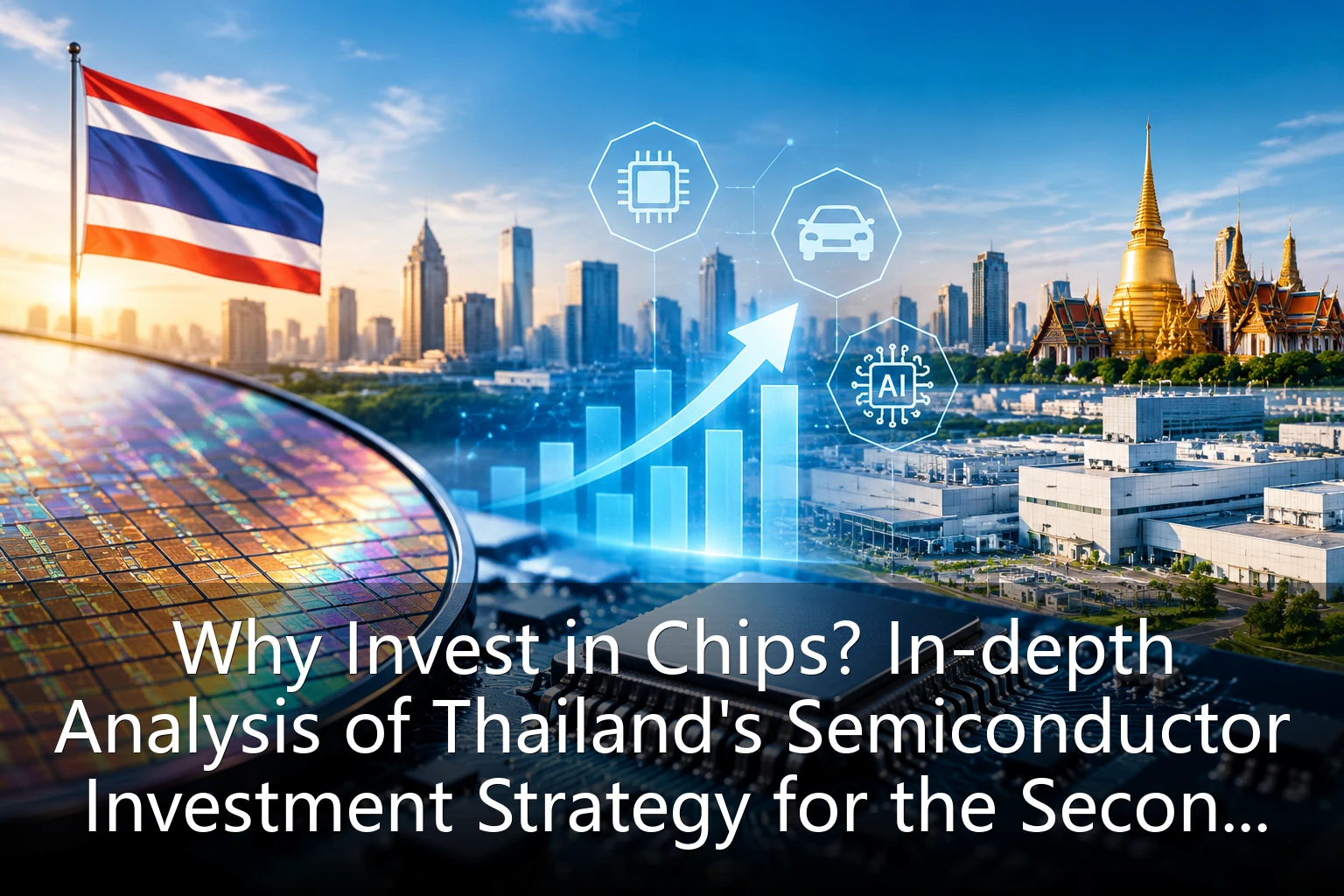
Why Invest in Chips? In-depth Analysis of Thailand's Semiconductor Investment Strategy for the Second Half of 2026
In today's increasingly intense global technology competition, the semiconductor industry has become a core component of national strategy. In 2026, with the rapid development of AI technology and the continuous expansion of the electric vehicle market, global demand for chips has reached unprecedented levels. As an important hub for semiconductor manufacturing in Southeast Asia, Thailand is becoming a focus of global investors with its unique industrial policy advantages and supply chain layout. This article will analyze in depth why 2026 is a critical time to invest in the chip industry and provide specific investment strategy recommendations for investors.
Global Semiconductor Industry Development Trends and Market Outlook
According to the latest data from the World Semiconductor Trade Statistics (WSTS), global semiconductor market sales in the first half of 2026 increased by 18.7% year-on-year, reaching $328 billion, setting a new high for the same period in history. Among them, the AI chip market performed particularly impressively, with sales growth exceeding 40% year-on-year, becoming the main engine driving the growth of the entire industry. Experts predict that as generative AI technology continues to mature and application scenarios expand, the global AI chip market size is expected to exceed $200 billion by 2027.
On the other hand, the rapid development of the electric vehicle market has also led to explosive growth in demand for automotive chips. In the first half of 2026, global electric vehicle sales increased by 35% year-on-year, and the tight supply of automotive chips has not been fundamentally alleviated. Especially key components such as high-performance computing chips, power semiconductors, and automotive sensors, market demand remains high.
Thailand's Unique Advantages and Policy Support in the Semiconductor Market
The Thai government has actively promoted the development of the semiconductor industry in recent years, attracting foreign investment through various preferential policies. In 2026, the Thailand Board of Investment (BOI) further relaxed investment restrictions in the semiconductor industry, providing corporate income tax exemptions of up to 8 years for key segments such as advanced packaging and testing, and wafer manufacturing, and implementing tariff concessions for related imported equipment and raw materials.
At the same time, leveraging its geographical advantages, Thailand is becoming an important node in the global semiconductor supply chain restructuring. Data from the Thailand Semiconductor Manufacturing Association (SMTA) shows that in the first half of 2026, Thailand's semiconductor product exports reached $28 billion, a year-on-year increase of 22.5%, with exports to ASEAN countries accounting for more than 40%. Thailand's semiconductor industry cluster effect is becoming increasingly evident, forming a complete industry chain from wafer manufacturing, packaging and testing to equipment maintenance.
Core Logic and Key Areas of Chip Investment
Investing in the chip industry requires a deep understanding of the internal logic of industry development. In the long term, the core logic of chip investment is mainly reflected in three aspects: technology innovation-driven, industry chain security needs, and market scale expansion.
First, technological innovation is the fundamental driving force for the development of the chip industry. Currently, chip technology is at a critical period of transitioning from 7nm to 5nm and 3nm, while innovations such as Chiplet technology and 3D stacking technology continue to emerge, injecting new vitality into industry development. Investors should focus on companies with advantages in technological innovation, especially those with core technologies in advanced packaging and testing, wafer manufacturing and other fields.
Second, the demand for industry chain security is increasingly prominent. In recent years, the global semiconductor supply chain has faced multiple challenges, and geopolitical factors, natural disasters and other factors may lead to supply disruptions. As a semiconductor manufacturing center in Southeast Asia, Thailand's strategic value in supply chain diversification is increasingly prominent. Investors should focus on companies with forward-looking supply chain layouts, especially international giants that have established stable production bases in Thailand.
Third, the continuous expansion of market scale brings long-term growth momentum to the chip industry. According to McKinsey Global Institute forecasts, by 2030, the global semiconductor market size is expected to exceed $1 trillion. Among them, AI chips, electric vehicle chips, industrial control chips and others will become main growth points.
Key Areas for Chip Investment in the Second Half of 2026
Based on the above analysis, in the second half of 2026, investors can focus on the following key areas:
- AI Chip Area: With the popularization of generative AI technology, demand for AI chips continues to rise. Especially the dedicated ASIC chip market, with its high performance and low power characteristics, is becoming a strong competitor to GPUs. Thailand's packaging and testing industry, with its technical advantages, has become an important base for global AI chip packaging and testing.
- Automotive Chip Area: The rapid development of the electric vehicle market has driven the growth of demand for automotive chips. Leveraging its automotive industry advantages, Thailand is actively building the automotive chip industry chain, especially in areas such as power semiconductors and automotive MCUs.
- Advanced Packaging and Testing Area: Thailand's packaging and testing industry achieved a capacity utilization rate of 92% in the first half of 2026, a historic high. Advanced packaging technologies such as Fan-out Packaging (FC) and Wafer Level Packaging (WLP) are becoming competitive advantages of Thailand's semiconductor industry.
- Wafer Manufacturing Area: Thailand is actively expanding wafer manufacturing capabilities, especially for mature process (28nm and above) wafer capacity. Investors can focus on international wafer manufacturers that are expanding production in Thailand.
Risk Analysis and Investment Recommendations
Although the chip industry has broad prospects, investors still face multiple risks. First, the risk of technological iteration cannot be ignored. Chip technology updates and iterations are fast, and investors need to continuously pay attention to technological development trends. Second, market volatility risk. The chip industry has obvious cyclical characteristics, and investors need to grasp the industry cycle. Third, geopolitical risk. The global semiconductor supply chain faces complex geopolitical challenges, and investors need to pay attention to relevant policy changes.
In response to the above risks, we propose the following investment recommendations:
- Long-term Investment Perspective: The chip industry is a capital-intensive industry with high technical barriers. Investors should adopt a long-term investment perspective and avoid interference from short-term market fluctuations.
- Diversified Allocation: It is recommended that investors adopt a diversified allocation strategy, dispersing investments in different segments such as chip design, manufacturing, packaging and testing, and equipment to reduce risks in a single segment.
- Focus on Policy Trends: Closely follow changes in semiconductor policies in Thailand and major global economies, especially policy adjustments in terms of tariffs and subsidies.
- Technology Route Judgment: deeply understand the development prospects of different technology routes and select companies with technological advantages for investment.
Conclusion
In the second half of 2026, the global semiconductor industry is in a critical transition period. The dual drivers of AI and automotive chip demand are injecting strong momentum into the industry. With its unique industrial policy advantages and supply chain layout, Thailand is becoming a new hotspot for global semiconductor investment. Investors should seize this historic opportunity, deeply understand the development laws of the chip industry, formulate scientific investment strategies, and achieve value growth in the golden age of semiconductors.