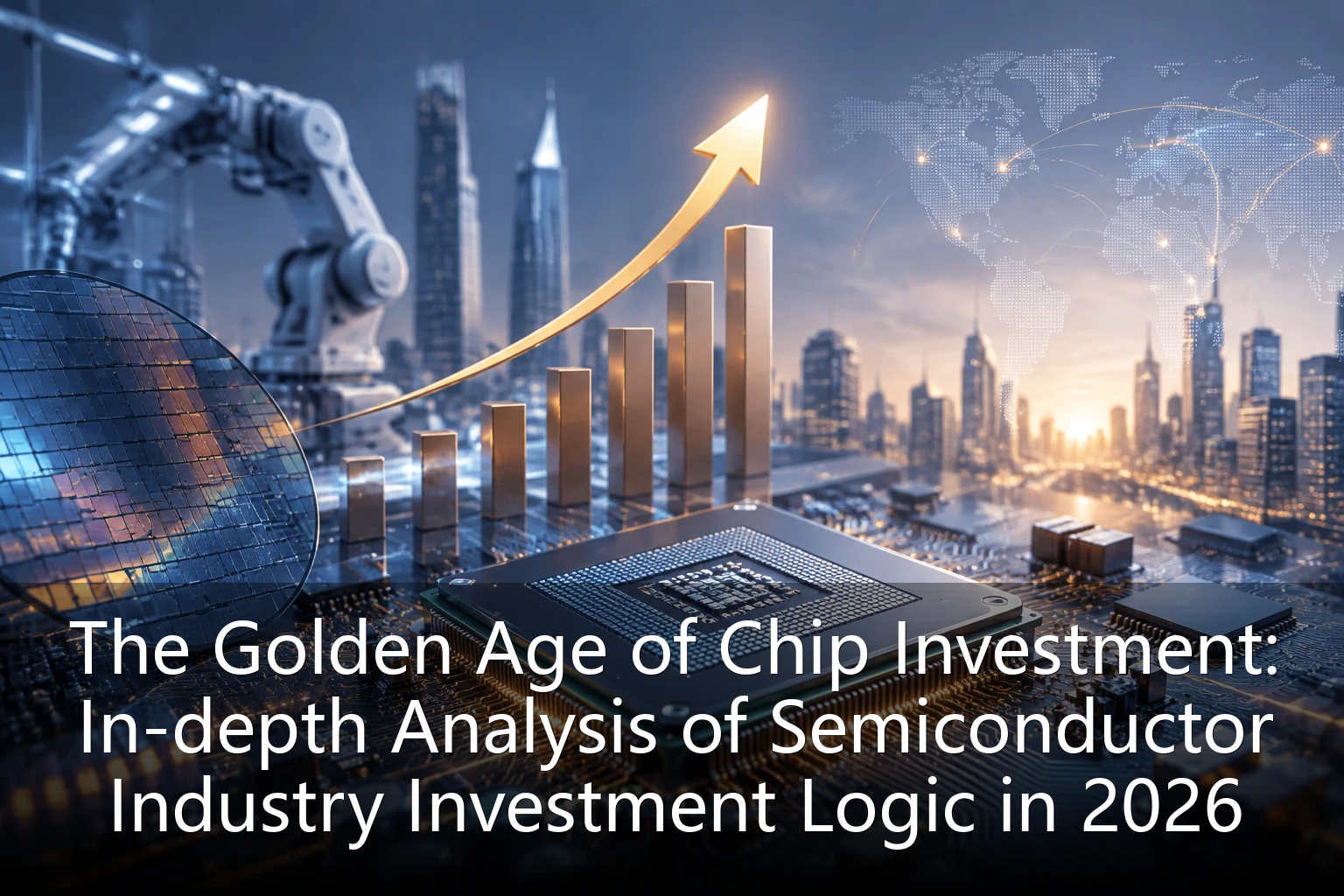
The Golden Age of Chip Investment: In-depth Analysis of Semiconductor Industry Investment Logic in 2026
At this critical juncture of 2026, the global semiconductor industry is undergoing unprecedented transformation and opportunities. With the rapid development of emerging technologies such as artificial intelligence, IoT, and 5G, chips, as the core driver of the digital economy, are increasingly highlighting their investment value. This article will conduct an in-depth analysis of the current chip industry investment logic from multiple dimensions, providing investors with a comprehensive and in-depth analytical perspective.
I. Policy Dividends: Unprecedented Global Semiconductor Industry Policy Support
In 2026, major global economies are increasing their support for the semiconductor industry, creating a favorable environment for chip investment. The U.S. government continues to invest funds through the "CHIPS and Science Act" to promote the expansion of domestic semiconductor manufacturing capacity; the EU has launched the large-scale "European Chips Act" aiming to enhance Europe's position in the global semiconductor supply chain; China continues to implement the Integrated Circuit Industry Investment Fund to support the R&D and industrialization of domestic chip technology.
Of particular note is the semiconductor investment super incentive package recently launched by the Thai government, which provides highly attractive policy support for investors. These policies not only include tax reductions and land use incentives but also cover comprehensive support such as talent training and supply chain配套设施, making Thailand a hot spot for semiconductor investment in Southeast Asia.
II. Domestic Substitution: Demand for Self-reliance Drives Chip Industry Upgrading
Under the current geopolitical landscape, the self-reliance of the semiconductor industry has become a focus of attention for countries. As the world's largest semiconductor consumer market, China is accelerating the process of chip localization. From design, manufacturing to packaging and testing, the entire industry chain is undergoing profound changes.
In the chip design field, domestic enterprises such as HiSilicon (Huawei) and UNISOC (Ziguang Zhanrui) are continuously breaking through technical barriers to launch competitive products; in the manufacturing segment, foundries like SMIC and Hua Hong Semiconductor are expanding capacity and improving process levels; in the packaging and testing sector, companies like JCET and Tongfu Microelectronics occupy important positions in the global market with their technical accumulation and cost advantages.
This trend of domestic substitution is not only present in China but is also evident in Southeast Asia. Countries like Thailand and Vietnam are actively attracting semiconductor investment to build regional chip industry chains, reducing dependence on traditional semiconductor powers.
III. Market Demand: Dual Engines of AI and Automotive Electronics Drive Growth
In 2026, semiconductor market demand shows a clear structural change, with artificial intelligence and automotive electronics becoming the two major growth engines. The rapid development of AI has raised higher demands for computing power, driving a surge in demand for products such as GPUs, AI chips, and memory chips. Especially in fields like generative AI, autonomous driving, and smart IoT, chip demand is experiencing explosive growth.
Meanwhile, the process of automotive electrification and intelligence is accelerating, and the automotive semiconductor market continues to expand. From traditional MCUs to advanced sensors and power devices, demand for automotive chips is growing comprehensively. According to industry analysis, the global automotive semiconductor market size is expected to exceed $100 billion by 2026, becoming an important growth point for the semiconductor industry.
This change in demand structure provides a clear direction for chip investors. Enterprises that can seize opportunities in AI and automotive electronics will gain significant growth dividends in the coming years.
IV. Technological Breakthroughs: Continuous Innovation in Semiconductor Processes and Architectures
Technological progress is the core driver of the semiconductor industry's development. In terms of processes, advanced process technologies such as 3nm and 2nm are continuously breaking through, improving chip performance and energy efficiency; in terms of architecture, new technologies like Chiplet and advanced packaging are changing traditional chip design concepts; in terms of materials, the application scope of third-generation semiconductors such as silicon carbide and gallium nitride is expanding.
Of particular note is the rise of the RISC-V architecture, which provides new options for chip design. This open-source instruction set architecture lowers the threshold for chip design and promotes innovation. In Thailand, the RISC-V ecosystem is gradually taking shape, providing new development opportunities for local chip design enterprises.
Additionally, frontier technologies such as quantum computing and neuromorphic computing are making continuous progress. Although they are still far from commercial application, they have already shown great potential, providing room for imagination for long-term investors.
V. Investment Strategies: Key Factors for Seizing Semiconductor Industry Investment Opportunities
Facing the investment opportunities in the semiconductor industry, investors need to adopt scientific investment strategies. First, pay attention to the integrity and synergy of the industry chain. Enterprises that can form synergistic effects in links such as design, manufacturing, and packaging/testing have stronger competitiveness.
Second, value technological innovation capabilities. In the semiconductor industry, technological leadership is the key to maintaining a competitive advantage. Investors should focus on enterprises that perform well in R&D investment, patent layout, and technological breakthroughs.
Third, pay attention to changes in market demand. With the development of emerging applications such as AI and automotive electronics, the demand for related chip products will continue to grow. Investors should closely monitor market dynamics in these fields and adjust their investment portfolios in a timely manner.
Fourth, consider geopolitical factors. The global layout of the semiconductor industry is facing challenges, and investors need to assess factors such as policy environments and supply chain stability in different regions to make reasonable investment decisions.
Finally, pay attention to valuation levels. Although the semiconductor industry has long-term growth potential, investors should also avoid blindly chasing high valuations and maintain a rational investment attitude.
VI. Thai Semiconductors: A New Focus for Chip Investment in Southeast Asia
In Southeast Asia, Thailand is becoming a new focus for semiconductor investment. The Thai government, through the BOI (Board of Investment), has launched a series of preferential policies to attract semiconductor enterprises to invest. These policies include tax reductions, land use incentives, talent training support, etc., providing a good investment environment for investors.
Thailand's semiconductor industry is mainly concentrated in the packaging and testing segment, with many internationally renowned packaging and testing enterprises. With the rise of advanced packaging technology, Thailand's packaging and testing capacity is moving towards high-end and diversified development. At the same time, Thailand is also actively developing wafer manufacturing and chip design capabilities to build a complete semiconductor industry chain.
For investors, Thailand's semiconductor industry offers diversified investment opportunities. Whether it is traditional packaging and testing business or emerging fields such as advanced packaging and SiC power devices, there is investment value. Especially in niche markets like AI chip packaging and automotive electronic packaging, Thai enterprises have obvious competitive advantages.
VII. Risk Warning: Challenges to Be Alerted for Semiconductor Investment
Although the semiconductor industry has broad prospects, investors also need to be alert to potential risks. First, the rapid pace of technological iteration and short product life cycles put enterprises under continuous pressure for technological innovation. Second, the risk of global semiconductor overcapacity still exists, especially in mature process segments. Third, geopolitical factors may affect the stability of the global supply chain. Finally, large R&D investment and long payback periods are also factors to consider for semiconductor investment.
Investors should fully assess these risks and adopt strategies such as diversified investment and long-term holding to cope with industry uncertainties.
VIII. Conclusion: The Right Time for Semiconductor Investment
Overall, the semiconductor industry in 2026 is in a golden period for investment. Multiple factors such as policy support, domestic substitution, market demand growth, and technological innovation work together to provide broad space for chip investment. Investors should seize this opportunity and share the dividends of the semiconductor industry's development through scientific investment strategies.
In Southeast Asian regions such as Thailand, semiconductor investment is ushering in new development opportunities. With the improvement of regional industry chains and technological progress, these regions are expected to become important growth poles of the global semiconductor industry. For investors, now is a good time to layout semiconductor investment, but it is also necessary to remain rational, do a good job in risk management, and achieve long-term stable investment returns.